


Ukraine’s petroleum products market continues to adapt to wartime risks, changing logistics conditions and new energy security requirements. In August and the first half of September, the key industry topics included an increase in the number of diesel fuel importers, the development of a strategic fuel reserve system, war-risk insurance for fuel transportation and the expansion of European fuel infrastructure.
In August 2026, diesel fuel was imported into Ukraine by 164 companies — the highest number of market participants in almost two years. Compared with July, the number of importers increased by 30, and compared with August 2025 — by 20.
The total volume of diesel fuel imports in August amounted to approximately 588,000 tonnes, which was 10% lower than during the same period last year. Due to increased risks along the southern route, the market made greater use of Ukraine’s western border. At the same time, the largest importers continued to rely on diversified logistics involving rail, road, sea and pipeline transport.
According to industry analytics, AT Energo Trade imported 55,600 tonnes of diesel fuel in August, placing the company among Ukraine’s largest fuel suppliers. The company doubled its rail deliveries while continuing to use several logistics routes. This approach helps maintain a stable supply of petroleum products to the industrial, agricultural, infrastructure and public sectors. Source: Enkorr/Delo.ua
In August, AT Energo Trade secured two major diesel fuel supply contracts.
The company will supply 2,460 tonnes of diesel fuel to Ukrgasvydobuvannya. Deliveries to be completed by 30 November 2026. Source: NaftoRynok
AT Energo Trade will also supply 2 million litres of diesel fuel to Kyivpastrans. Source: NaftoRynok
The results of these procurement procedures confirm AT Energo Trade’s ability to fulfil large-scale contracts and ensure an uninterrupted wholesale supply of petroleum products to critical infrastructure enterprises.
The Cabinet of Ministers of Ukraine has launched a pilot project for the underground storage of petroleum products forming part of the country’s minimum oil and petroleum product reserves.
The project will remain in effect during martial law, but for no longer than two years from the date on which the relevant resolution enters into force. Starting in 2027, market participants are expected to store at least 20% of the total volume of diesel fuel included in the minimum reserve system in underground storage facilities.
At the same time, the full implementation of the minimum reserve system has been postponed until at least 1 January 2027. Before then, issues related to financing, participant responsibilities, insurance and access to storage infrastructure must be addressed. Source: NaftoRynok
The creation of strategic reserves is intended to strengthen the resilience of the fuel market and maintain the availability of petrol, diesel fuel and other petroleum products in the event of a disruption to supply.
Petroleum product logistics remains one of the most challenging areas under wartime conditions. Industry examples show that large specialised carriers can transport up to 6,000 tonnes of fuel per day, supporting the operation of filling stations, industrial enterprises, agricultural businesses and critical infrastructure.
Another important step in supporting fuel logistics was the extension of war-risk insurance mechanisms to cover fuel and tanker trucks. This is a significant development for the market, as insurance coverage can help reduce the financial risks associated with transporting petroleum products across Ukraine. Source: NaftoRynok
Today, supply reliability depends not only on the availability of sufficient resources but also on the ability to quickly change routes, combine different modes of transport and ensure the safe storage of petroleum products.
A new marine transshipment terminal for petroleum products and biofuel components has begun operating in Gdańsk, Poland. During its first year, the terminal is expected to handle approximately 100 vessels and around 500,000 tonnes of cargo. Its annual capacity may eventually increase to between 1.8 million and 2 million tonnes.
The development of European port infrastructure helps shorten supply chains, improve the flexibility of maritime deliveries and create additional routes for international petroleum product trading. Source: NaftoRynok
For the Ukrainian market, access to advanced infrastructure in European countries is particularly important, as it expands the opportunities for supplying diesel fuel, petrol, LPG, bitumen and other petroleum products.
Tensions in the Middle East are creating additional risks for the global oil and petroleum products market. Potential consequences include disruption to maritime logistics, higher freight and vessel insurance costs, and a possible shortage of marine fuel.
These factors may affect not only maritime transportation but also the prices and delivery times of diesel fuel, petrol, liquefied petroleum gas, bitumen and other petroleum products. Diversified logistics routes and the ability to use several modes of transport therefore remain essential to maintaining stable wholesale petroleum product supplies. Source: NaftoRynok
The PROkachai AZS 2026 industry event will take place on 22–23 September with the support of AT Energo Trade.
We invite our partners and counterparties to attend the event and meet the AT Energo Trade team in person. Our managers will be available to discuss cooperation, current business requirements and opportunities for large- and small-scale wholesale supplies of Euro 5 diesel fuel and petrol, LPG, bitumen and other petroleum products from Europe.
See you at PROкачай АЗС 2026!

AT Energo Trade Supports the Development of Veterans’ Leadership Potential in Ukraine
AT Energo Trade supports socially important initiatives and projects aimed at supporting Ukrainian defenders.
More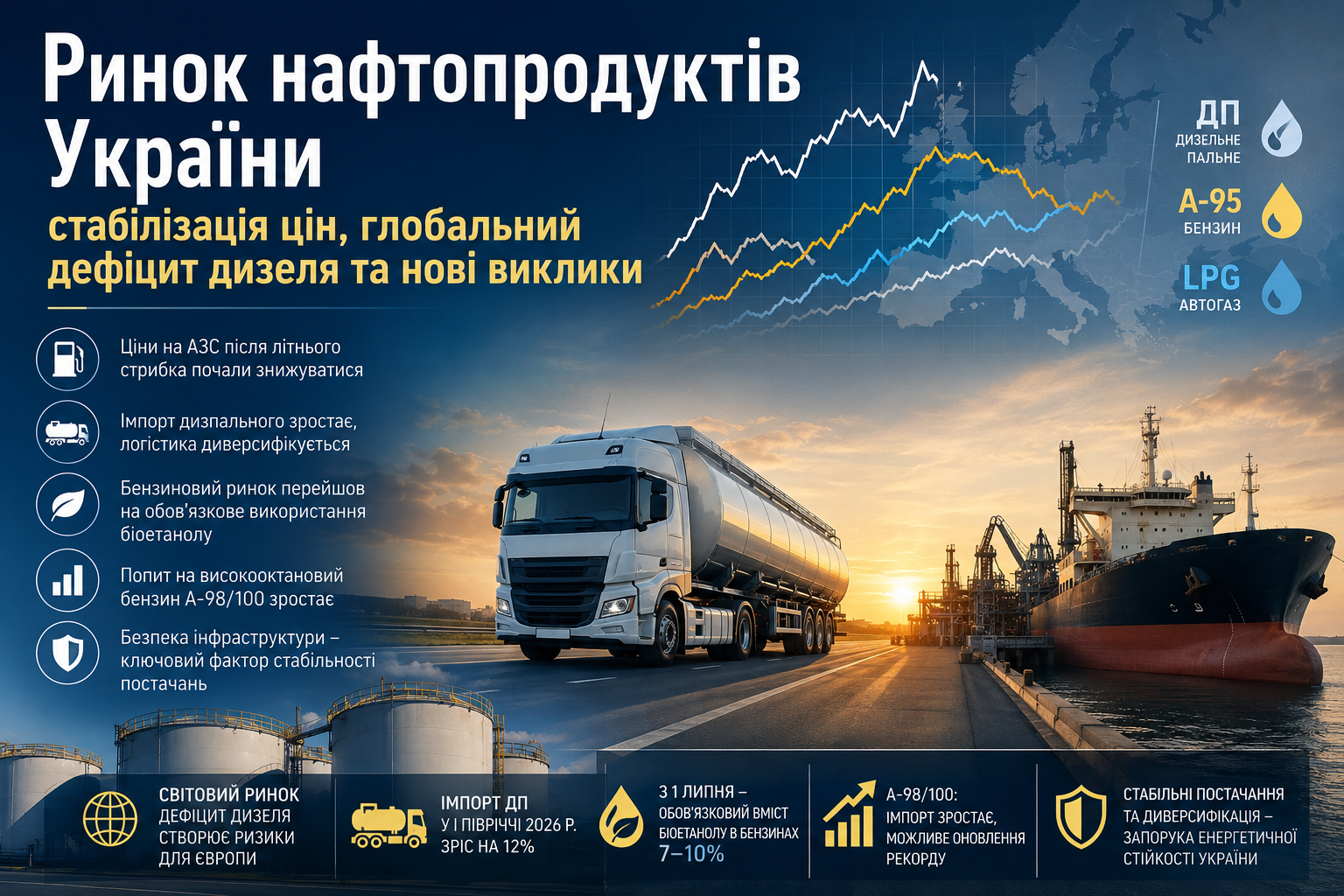
Ukraine’s Oil Products Market in July
Ukraine’s oil products market is showing the first signs of stabilization in August after a sharp increase in fuel prices over the summer. Retail prices for gasoline, diesel fuel and LPG have declined slightly in recent days, although the global market remains under pressure. The main risk for Ukraine is a reduction in global diesel […]
More
The number of oil and gas rigs in the world in March decreased due to Canada
The number of active oil and gas rigs in the world decreased in March due to Canada. This was announced by the American oil service company Baker Hughes. On average, there were 1,793 installations worldwide last month, compared to 1,813 in February. At the same time, the March level is 86 lower than the indicator […]
More
The Ministry of Finance plans to introduce advance income tax payments for fuel companies
In order to increase the revenues of the state budget of Ukraine in 2024, the government plans to introduce monthly advance payments of income tax by enterprises engaged in fuel retailing. This was reported by the Ministry of Finance of Ukraine in response to the request of the Interfax-Ukraine agency. In addition, the Ministry of […]
More
TOP-10 importers of motor vehicle fuel in 2023
NaftoRynok has compiled a rating of suppliers of imported fuel (gasoline, diesel and LPG) for vehicles for 2023. The TOP-10 includes wholesale and retail companies represented by national and local gas station chains. The absolute leader was the company “Ukrpaletsistem” (UPG gas station network), which occupies the first place in the auto import of gasoline […]
More
Small group: European quotations are under pressure
Small group prices are gradually increasing, feeling the pressure of the foreign market. But due to low demand and a sufficient number of offers, prices do not fully respond to external stimuli, sometimes remaining lower than the cost price of new batches of imported resources. From January 26 to February 1, European diesel fuel quotations […]
More
They founded an extremely important project – a grant for students of the Ostroh Academy National University.
By the way, this is the second year that our BF “Help.AET” helps students of this university with free grants for studies. This grant should materially support the development of the academic community and stimulate the achievement of high academic results. We believe that the future of our country depends on intellectual and creative individuals. […]
More
Alliance Energо Trade is a partner of Petroleum & LPG Ukraine 2023
One of the leaders of the wholesale fuel market — “Alliance Energо Trade” — will act as a partner of the Petroleum & LPG Ukraine 2023 conference, which will be held on December 5 in Kyiv. “We are glad that the long-standing traditions of partnership within our forum are preserved despite the war. With us […]
More
Approaching victory: “Alliance Energо Trade” strengthened the Ukrainian defenders
On October 16, the company “Alliance Energо Trade” (AET) handed over a car tank for the transportation of fuel to the 228th separate logistics battalion. This was reported to enkorr in the company’s press service. “This is a high-quality Kassbohrer STS-35 tank with a volume of 35 m3 on a modern chassis,” noted Petro Bilko, […]
More