


Ukraine’s petroleum products market entered mid-autumn amid high prices, shifts in the import mix and ongoing security challenges. Suppliers are adapting fuel logistics, businesses are planning purchases more carefully, and protected fuel storage remains an industry priority. Meanwhile, figures for the first nine months of the year, released in early October, show that cumulative diesel and petrol imports exceeded last year’s levels despite a decline in September. Ukrainian bioethanol exports and fuel excise tax revenues are growing, while international flows of crude oil and petroleum products continue to shift.
According to figures published by Enkorr on 7 October, Ukraine imported 537,000 tonnes of diesel fuel in September. This was 9% below August’s volume and 21% lower than in September 2025. However, imports for January–September reached 4.7 million tonnes, up 3% year on year. The publication attributed September’s decline to weak demand, the impact of attacks on industry, difficulties exporting agricultural products and high prices. The geographical mix of supplies also changed: the southern route’s share fell to 41%, compared with 52% a year earlier. Poland remained the largest supplying country, accounting for 203,000 tonnes, while Lithuania supplied 66,000 tonnes.
AT Energo Trade ranked fourth among Ukraine’s largest diesel importers in September, importing approximately 44,000 tonnes. This result reflects the scale of the company’s contribution to supplying the Ukrainian fuel market.
Ukraine’s petrol imports totalled 145,000 tonnes in September. Volumes fell by 5% compared with August but remained 3% above September last year. Over the first nine months of 2026, motor petrol imports reached 1.26 million tonnes, up 15% compared with the same period in 2025. According to Enkorr, the monthly decline reflected a seasonal reduction in consumption and high retail prices, which encouraged motorists to economise. Lithuania and Poland remained the main supplying countries, together accounting for 57% of September’s imports.
Individual supply routes showed different trends. Deliveries from Romania increased by 29% compared with August to 30,100 tonnes, while shipments from Greece fell by 28% to 10,800 tonnes. The overall monthly decline was therefore accompanied by a redistribution of supplies between countries. For market participants, this highlights the importance of flexible petrol import planning and access to multiple sources of supply.
In late September and early October, AT Energo Trade was selected as the winner of three diesel fuel procurement tenders for JSC Ukrgasvydobuvannya and JSC Ukrzaliznytsia. The procurement for Ukrgasvydobuvannya provides for the supply of 2,500 tonnes of diesel worth UAH 255.35 million, including VAT. Two further tenders conducted by Ukrzaliznytsia’s Production Support Centre branch provide for deliveries of 2,000 tonnes each, worth UAH 188.64 million and UAH 190.08 million, including VAT, respectively. Total planned deliveries under these tenders amount to 6,500 tonnes of diesel fuel.
Underground storage of petroleum products emerged as a prominent topic in early October. In an article published on 6 October, NaftoRynok examined the potential for developing protected storage facilities as part of establishing minimum stocks of crude oil and petroleum products. The discussion followed an experimental project provided for by a government resolution dated 13 August 2026.
Potential solutions include bunker-type facilities with steel tanks housed inside protective reinforced-concrete structures, as well as storage in geological formations. Each option requires dedicated engineering work and an assessment of site suitability, costs and implementation timelines. For the fuel market, this discussion is important for supply resilience. Protected stocks could form part of a system that helps manage disruptions and reduce infrastructure vulnerability. However, the existence of a project does not mean that completed storage facilities have already entered operation.
According to NaftoRynok, citing responses from the tax and customs authorities, fuel excise tax revenues totalled UAH 104.6 billion in January–September 2026. In the third quarter, fuel excise revenues reached UAH 35.8 billion, up 10.4% compared with the same period last year. The publication primarily attributed the increase to higher excise rates introduced at the beginning of 2026 and the depreciation of the hryvnia.
This context matters when interpreting the figures: rising tax revenues alone do not indicate a proportional increase in physical fuel consumption. Separate figures were also released on advance tax payments by filling station operators. Over the first nine months, combined advance payments of corporate income tax and personal income tax totalled approximately UAH 2.7 billion, up 5.4% year on year. The two categories followed different trends: advance corporate income tax payments increased by 6%, while advance personal income tax payments declined by 5.6%.
As of 1 September 2026, Ukraine had 5,404 registered fuel retail licences, an increase of 198 since the beginning of the year. The wholesale segment recorded a decline over the same period. The number of licences for wholesale trading without wholesale premises fell from 1,801 to 1,710, while licences for trading with wholesale premises decreased from 412 to 399. These figures represent licence numbers. They should not automatically be equated with the number of individual companies or newly opened filling stations. Nevertheless, they help track changes in the structure of licensed activity in Ukraine’s fuel market.
NaftoRynok estimates that Ukraine exported 123,400 tonnes of bioethanol in January–September 2026, up 36.6% compared with the same period last year. Lithuania remained the largest destination, receiving 84,700 tonnes, or 68.6% of total exports. Shipments to Romania, Poland and Switzerland also increased. Meanwhile, the 125,000-tonne duty-free quota for Ukrainian ethanol exports to the EU was exhausted in September. This is a separate measure and should not be confused with the bioethanol export volume cited above. As overseas shipments grow, the development of Ukraine’s domestic market for biofuel components remains an important industry topic. Key business considerations include the economics of producing finished fuel blends, access to export markets and the conditions for using Ukrainian products domestically.
In late September, Saudi Arabia resumed crude oil shipments through the Red Sea port of Yanbu after the East–West pipeline returned to operation. In early October, NaftoRynok reported that crude oil exports from the Middle East had exceeded pre-conflict levels on certain days during the final week of September. Preliminary estimates for those days ranged from 19.5 million to 22.5 million barrels per day, while the seven-day average to 1 October stood at 18.5 million barrels per day. However, the risk of attacks on vessels persisted. Shipment volumes were recovering while maritime logistics remained exposed to security threats.
India’s middle distillate exports reached approximately 740,000 barrels per day in September, their highest level of the year. Gasoil shipments totalled 586,000 barrels per day. According to NaftoRynok’s report of 13 October, the increase was supported by overseas demand and declining diesel stocks in Europe. A reduction in Indian export taxes in September provided an additional incentive. Middle distillate shipments to Europe and the Mediterranean region reached 298,000 barrels per day. This trend illustrates how the European market is attracting additional supplies from more distant sources in response to a tight supply balance.
According to NaftoRynok’s report of 13 October, German market participants expect demand for HVO100 to roughly double in 2026 compared with 2025. One of the main drivers is the narrowing price gap between HVO100 and conventional diesel. In some market segments, HVO100 has become cheaper, increasing interest among agricultural businesses and commercial fleet operators.
Over the first nine months of the year, Tajikistan increased petroleum product imports from Iran to 15,600 tonnes, compared with 3,500 tonnes a year earlier. Supplies from Turkmenistan also rose significantly. These changes took place as the country sought alternative sources of fuel supply. Syria, meanwhile, announced plans to increase oil production from approximately 110,000 to 250,000 barrels per day by the end of 2027. According to Enkorr, achieving these targets will depend on investment, equipment and infrastructure rehabilitation. These are long-term plans rather than additional supplies already available on the global market.
A key industry event in September was the PROkachai AZS 2026 exhibition and conference, held in Kyiv on 22–23 September. AT Energo Trade supported the event under the “With the Support of” sponsorship package, while the company’s managers participated in professional discussions on the fuel market.
The trading session addressed price volatility, the challenges of forecasting purchases, logistics capacity and the outlook for fuels containing biocomponents. Participants highlighted shorter planning horizons: market changes while a shipment is in transit make it harder to assess the terms under which it can subsequently be sold.
Discussions in the petrol segment covered demand for finished A-95-E10 petrol and the prospects for premium A-98 and A-100 grades. Access to multiple supply sources and routes remained a common concern across market segments. We thank the organisers of PROkachai AZS 2026 for the opportunity to discuss industry challenges openly, and our partners and all participants for the meetings, exchange of experience and meaningful conversations. For the AT Energo Trade team, events like this offer an opportunity to better understand businesses’ needs and work together on solutions for reliable fuel supply.
This autumn’s fuel market developments demonstrate how closely Ukrainian purchasing is linked to global petroleum product flows, transport infrastructure and the security situation.
For businesses buying diesel fuel wholesale or planning regular petrol purchases, it is important to consider the entire supply cycle: product availability, payment terms, transit times and the ability to adjust delivery routes.
AT Energo Trade meets the wholesale petroleum product supply needs of Ukrainian businesses. Contact the company’s managers to discuss volumes, delivery schedules and current supply terms.

Ukraine’s Petroleum Products Market: Key Events of August and September 2026
An overview of Ukraine’s petroleum products market: diesel fuel imports, strategic reserves, fuel logistics, wartime risks and PROкачай АЗС 2026.
More
AT Energo Trade Supports the Development of Veterans’ Leadership Potential in Ukraine
AT Energo Trade supports socially important initiatives and projects aimed at supporting Ukrainian defenders.
More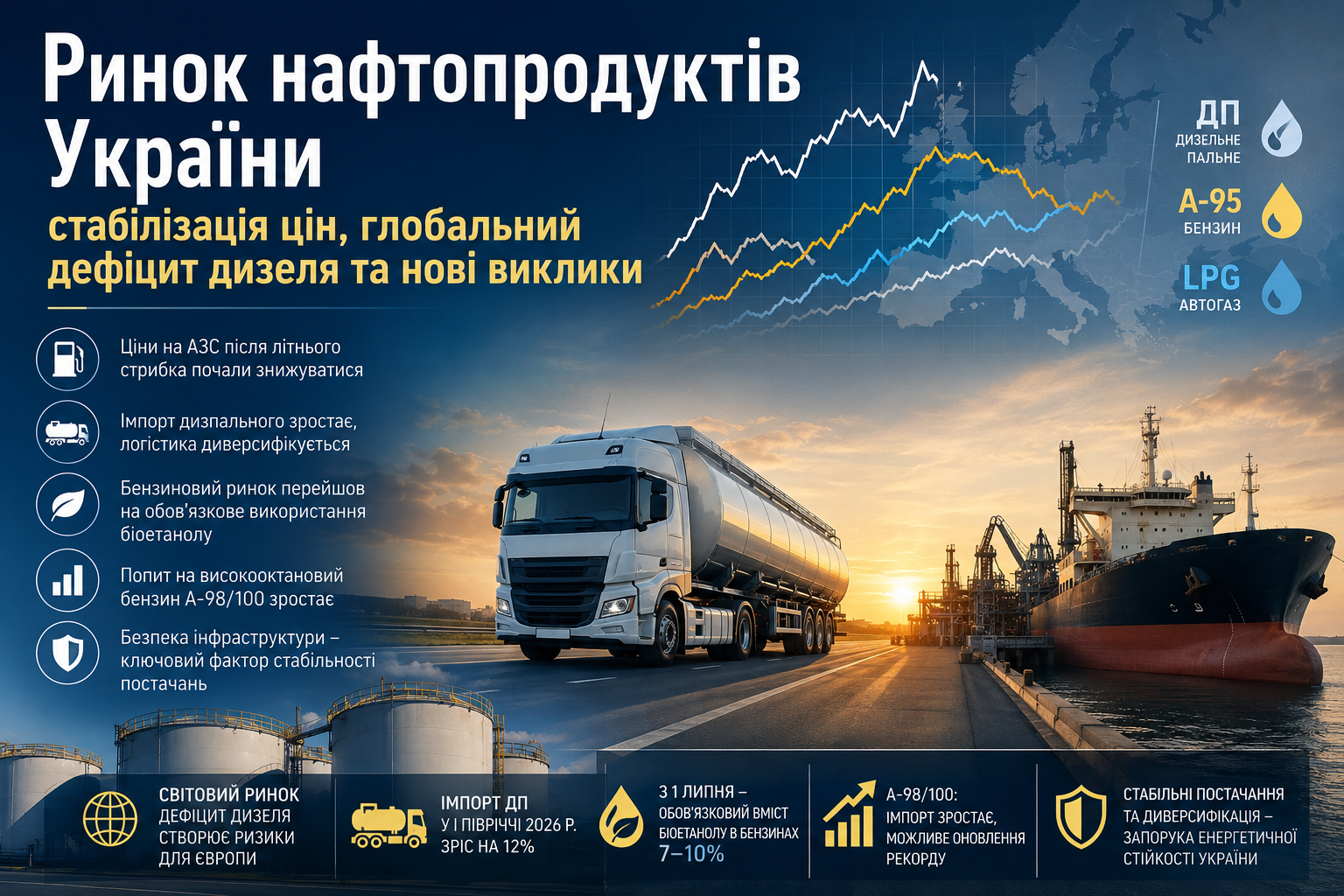
Ukraine’s Oil Products Market in July
Ukraine’s oil products market is showing the first signs of stabilization in August after a sharp increase in fuel prices over the summer. Retail prices for gasoline, diesel fuel and LPG have declined slightly in recent days, although the global market remains under pressure. The main risk for Ukraine is a reduction in global diesel […]
More
The number of oil and gas rigs in the world in March decreased due to Canada
The number of active oil and gas rigs in the world decreased in March due to Canada. This was announced by the American oil service company Baker Hughes. On average, there were 1,793 installations worldwide last month, compared to 1,813 in February. At the same time, the March level is 86 lower than the indicator […]
More
The Ministry of Finance plans to introduce advance income tax payments for fuel companies
In order to increase the revenues of the state budget of Ukraine in 2024, the government plans to introduce monthly advance payments of income tax by enterprises engaged in fuel retailing. This was reported by the Ministry of Finance of Ukraine in response to the request of the Interfax-Ukraine agency. In addition, the Ministry of […]
More
TOP-10 importers of motor vehicle fuel in 2023
NaftoRynok has compiled a rating of suppliers of imported fuel (gasoline, diesel and LPG) for vehicles for 2023. The TOP-10 includes wholesale and retail companies represented by national and local gas station chains. The absolute leader was the company “Ukrpaletsistem” (UPG gas station network), which occupies the first place in the auto import of gasoline […]
More
Small group: European quotations are under pressure
Small group prices are gradually increasing, feeling the pressure of the foreign market. But due to low demand and a sufficient number of offers, prices do not fully respond to external stimuli, sometimes remaining lower than the cost price of new batches of imported resources. From January 26 to February 1, European diesel fuel quotations […]
More
They founded an extremely important project – a grant for students of the Ostroh Academy National University.
By the way, this is the second year that our BF “Help.AET” helps students of this university with free grants for studies. This grant should materially support the development of the academic community and stimulate the achievement of high academic results. We believe that the future of our country depends on intellectual and creative individuals. […]
More
Alliance Energо Trade is a partner of Petroleum & LPG Ukraine 2023
One of the leaders of the wholesale fuel market — “Alliance Energо Trade” — will act as a partner of the Petroleum & LPG Ukraine 2023 conference, which will be held on December 5 in Kyiv. “We are glad that the long-standing traditions of partnership within our forum are preserved despite the war. With us […]
More