The number of oil and gas rigs in the world in March decreased due to Canada

The number of active oil and gas rigs in the world decreased in March due to Canada. This was announced by the American oil service company Baker Hughes.

On average, there were 1,793 installations worldwide last month, compared to 1,813 in February. At the same time, the March level is 86 lower than the indicator for the same month of 2023.

In the US, the number of installations in March increased by 2 compared to the previous month and amounted to 625. Meanwhile, in Canada, their number fell by 35 to 197.

The number of rigs in the Middle East decreased by 5 last month (to 344). At the same time, their number increased by 10 (up to 229) in the Asia-Pacific region, by 4 (up to 118) in Europe, and by 4 (up to 115) in Africa. In Latin America, as before, there were 165 rigs (the lowest figure since July 2022).

Baker Hughes has been publishing data on rigs in operation since 1944. At first, the company collected information only in the USA and Canada, since 1975 – all over the world. Since June 2019, it has included in its calculations the number of drilling rigs in Ukraine, while the recalculation of consolidated data for Europe for past periods was not carried out in this regard.

The average monthly number of oil and gas drilling rigs operating in the world in 2023 increased for the third year in a row. The figure rose to 1,814 units compared to 1,747 in 2022.

According to the mass media, the historical maximum in terms of the number of working drilling rigs was recorded in 1981 — 5,624 rigs. The minimum number was recorded in 2020, it was 1,352 units.

Source: enkorr.ua

The Ministry of Finance plans to introduce advance income tax payments for fuel companies

In order to increase the revenues of the state budget of Ukraine in 2024, the government plans to introduce monthly advance payments of income tax by enterprises engaged in fuel retailing. This was reported by the Ministry of Finance of Ukraine in response to the request of the Interfax-Ukraine agency.

In addition, the Ministry of Finance still plans to increase excise taxes on fuel. “The proposals also provide for bringing the excise tax on fuel in line with EU minimum standards, introducing an excise tax on water, including mineral and carbonated water, with the addition of sugar or other sweeteners or aromatic substances, and expanding the list of excisable goods due to excise tax on plants hemp,” the message states.

The minimum excise duty rates according to the European Commission directive 2003/96/EC are: for gasoline – €359 per 1 thousand liters, for diesel fuel – €330 for 1 thousand liters, for liquefied gas – €125 for 1 thousand liters.

It is expected that the Verkhovna Rada will consider the relevant draft laws by the end of the first quarter of 2024, the ministry said.

We will remind, at the end of January, NaftoRynok reported that the Ministry of Finance has been working on a draft law on increasing excise duty rates on all types of motor fuel to €359/1000 l since 2022, with a transition period until the end of 2027.

Source: https://www.nefterynok.info/novosti/mnfn-planu-zaprovaditi-avansov-vneski-podatku-na-pributok-dlya-palivnih-kompany

TOP-10 importers of motor vehicle fuel in 2023

NaftoRynok has compiled a rating of suppliers of imported fuel (gasoline, diesel and LPG) for vehicles for 2023. The TOP-10 includes wholesale and retail companies represented by national and local gas station chains. The absolute leader was the company “Ukrpaletsistem” (UPG gas station network), which occupies the first place in the auto import of gasoline and diesel, and the second in the supply of liquefied gas by gas carriers, according to the analysis of the oil products market for 2023, published in the January issue of NR Monthly fuels&LPG 2024

Thus, WOG (4.90%), UNTK (3.95%), VST (3.72%), AMIC (3.59%), and the undisputed leader became UPG (20.25%).

In addition, UPG continued to occupy the first position among importers of diesel fuel for vehicles. During 2023, the company’s share in the market of state-owned enterprises’ suppliers amounted to 6.3%.

Among importers of LPG by motor vehicle in 2023, the company took second place with a share of 4.6%.

As a reminder, according to the results of 2023, the company “Ukrpaletsistem” (operating under the UPG gas station brand) entered the top three importers of diesel fuel. Importers OKKO, WOG and UPG provided almost 30% of the supplies of SE. As reported by NaftoRynok, UPG found producers of oil products in other continents besides Europe. In particular, the company supplied diesel fuel from the USA, Kuwait and Oman. The company operates about 450 vehicles (petrol trucks and gas trucks) that run direct routes from foreign terminals to UPG gas stations and industrial fuel consumers.

A detailed overview of the gasoline, diesel and other petroleum products markets with handy infographics can be found in the January 2024 issue of NR Monthly fuels&LPG.

Source: https://www.nefterynok.info/novosti/za-pdsumkami-2023-r-upg-ldiru-v-postachann-palnogo-avtotransportom-dosldjennya

Small group: European quotations are under pressure

Small group prices are gradually increasing, feeling the pressure of the foreign market. But due to low demand and a sufficient number of offers, prices do not fully respond to external stimuli, sometimes remaining lower than the cost price of new batches of imported resources.

From January 26 to February 1, European diesel fuel quotations increased by $19/t: in the Mediterranean – to $851-869/t, in the south – to $859-868/t. But gasoline prices have decreased by $4/t over the last five days, to $808-826/t and $858/t. In general, in January, the foreign market increased by $55-62/t for gasoline and $97-106/t for DP.

Borders work

As of the morning of February 1, traffic across the Polish-Ukrainian border was quite intense. As reported by Ukrinform with reference to the broadcast of the telethon “Yedini Novyny”, the spokesman of the State Border Service of Ukraine, Andriy Demchenko, said that now in a day, from 1,000 to 1,400 trucks pass through the checkpoint “Yagodin-Dorogusk” in both directions, “Korchova-Krakivets” » – 600, through “Grebenne-Rava-Ruska” and “Medyka-Sheghini” – 500 trucks per day.

The unlocking of the Ukrainian border with Poland continues to affect the supply of diesel fuel by road transport, which has increased for the second week in a row. Last week, 15.63 thousand tons of diesel were imported by gasoline trucks from Poland and the Baltic countries, which is 35% more than the previous week.

At the same time, the supply of gasoline from these directions by gasoline tankers decreased by 10%, to 2.43 thousand tons.

At the beginning of the week, there was an accident at the catalytic cracking unit at the Mazeikiai Refinery (Orlen Lietuva). Market participants say that this has not yet affected the supply of fuel from the plant to Ukraine.

“But for the next week, Orlen significantly increased the premium for fuel: for gasoline it increased by €27/t, for DP – by €64/t,” said one of the importers of Lithuanian fuel.

As of February 2, Ukrainian companies have increased prices for fuel shipped from Lithuanian bases next week. According to the telegram channel of the UNTK company, the price of gasoline, depending on the base, increased by 0.5-0.6 UAH/l, to 41.00-41.5 UAH/l, private sector – by 2.00-2.2 hryvnias/l, up to 42.5-43.2 hryvnias/l.

The movement of fuel tankers across the Ukrainian-Romanian border takes place as usual. According to the “eCherga” service, as of February 2, there are only 47 cars in the queue to leave Ukraine through the Porubne-Siret checkpoint.

Traders note a significant improvement in diesel shipments by rail from Constanta. According to them, the reason for this is the decrease in demand for railway consignments.

In general, from January 22 to 28, imports of state-owned enterprises into the country by gasoline trucks increased by 9% compared to the previous week, to 25.4 thousand tons, and by 19% more than in the last seven days of December.

At the same time, the supply of diesel by rail transport increased by 35%, up to 54.1 thousand tons. Growth was recorded in all directions.

As previously reported by enkorr, this week the GTS company started supplying diesel fuel by rail to the west of Ukraine

3 From January 22 to 28, the total volume of gasoline imports decreased by only 90 tons, to 5.01 thousand tons, and compared to the end of December, it increased by 5%. The supply by railway decreased by 7%, to 14.9 thousand tons. This happened due to the halving of imports from Slovenia and the absence of railway consignments from Lithuania.

Prices have increased

Demand for fuel in the country remains low. But this week, traders from the south of the country noted a slight revival.

From January 29 to February 2, the price of diesel fuel in the south varied between UAH 42.75-45/l. At the end of the week, the company “Exxon Yuk” (belongs to the “Trade Commodity” group) entered the market with an offer of winter fuel at a price 0.7-0.8 UAH/l (43.2-43.3 UAH/l) cheaper than the regional average.

The upper limit is offered by SE WOG, “Martin Trade”, “Alliance Energo Trade”. At the same time, as of February 2, the cost of imported resource at “Continental Trade” is UAH 43.45/t, Quorum – UAH 43.4/l, UNTK – UAH 43.8/l.

“Currently, we are selling the resource with a minimal markup, there is no margin,” one of the companies shared the current results.

In the west, diesel was offered at 43.25-45.5 UAH/l. It should be noted that fuel companies operating in this direction continue to receive the resource contracted back in December at prices lower than now.

Trade in A-95 gasoline in the western direction was in the range of 42.75-45 UAH/l, in the southern regions of the country the same resource was traded in the range of 42.5-45.5 UAH/l.

European quotations and exchange rates remain the main factors pushing up fuel prices. “Weekly contracts from Lithuania will be 100 percent higher than this week. But it is difficult to say about other prices, since the quotations do not have stable dynamics”, – shared the opinion of one of the importers.

Source: https://enkorr.ua/uk/news/drbniy_gurt_vropeysk_kotiruvannya_tisnut/257947

They founded an extremely important project – a grant for students of the Ostroh Academy National University.

By the way, this is the second year that our BF “Help.AET” helps students of this university with free grants for studies.

This grant should materially support the development of the academic community and stimulate the achievement of high academic results.

We believe that the future of our country depends on intellectual and creative individuals. So, with the help of this grant, we want to give students the opportunity to develop their potential, overcome challenges and achieve great results. 

Ostroh Academy is a real pearl of the history of education! Founded in the 16th century by Prince Konstantin Ostrozky, it was one of the first educational institutions of a new type throughout Eastern Europe. Therefore, it is twice as pleasant for us to help the students of such an ancient educational institution!

This project is our commitment to the future leaders and intellectuals of Ukraine.

Together we will grow and create a bright future for Ukraine!

Alliance Energо Trade is a partner of Petroleum & LPG Ukraine 2023

One of the leaders of the wholesale fuel market — “Alliance Energо Trade” — will act as a partner of the Petroleum & LPG Ukraine 2023 conference, which will be held on December 5 in Kyiv.

“We are glad that the long-standing traditions of partnership within our forum are preserved despite the war. With us again are market leaders who, despite the war, kept their positions and showed an example of stability in extremely difficult conditions,” said Serhiy Kuyun, director of the “A-95” Consulting Group, which is the organizer of the conference.

By 2022, “Alliance Energy Trade” (AET) steadily occupied a place among the leading suppliers of light petroleum products and bitumen, which it has retained to this day.

The company was one of the first to be hit by the Russian occupiers, who attacked oil depots and two AET trucking enterprises in the Gostomel district of Kyiv region, destroying 140 tractors and tankers.

Despite the loss, AET was one of the first to start importing oil products from Europe in the spring of 2022.

Also, “Alliance Energо Trade” is known as the largest taxpayer among wholesale suppliers. Yes, according to the publication “Rating. Business in official figures”, in January-September 2021, the company paid UAH 219.8 million in taxes and fees to the state budget.

Currently, the company supports the Defense Forces of Ukraine and the civilian population affected by the war in several ways. Among the most recent projects is the transfer to the 228th separate logistics battalion of the Kassbohrer STS-35 tank truck with a volume of 35 m3, which was implemented with the participation of the “A-95” Consulting Group.

The first Petroleum Ukraine conference was held in 2009, and over the next 10 years, the site became a meeting place for the active part of the Ukrainian fuel market. Due to the full-scale invasion of Russia into Ukraine and a radical change in the supply system of petroleum products in 2022 and 2023, Petroleum Ukraine took place in Warsaw.

The draft program and registration form for participation in Petroleum & LPG Ukraine 2023 are already available on the website of the A-95 Consulting Group.

Source: https://enkorr.ua/uk/news/alyans_energo_treyd_partner_petroleum_lpg_ukraine_2023/257067

Approaching victory: “Alliance Energо Trade” strengthened the Ukrainian defenders

On October 16, the company “Alliance Energо Trade” (AET) handed over a car tank for the transportation of fuel to the 228th separate logistics battalion. This was reported to enkorr in the company’s press service.

“This is a high-quality Kassbohrer STS-35 tank with a volume of 35 m3 on a modern chassis,” noted Petro Bilko, head of the company’s logistics department. According to him, this semi-trailer is the sixth unit that the company has given to the military since the beginning of the full-scale invasion. Prior to this, AET had already transferred 5 units of equipment with a total cost of about 3.9 million UAH from its own fleet to various units of the Armed Forces. The press service of AET also noted that the transfer of equipment is only part of a large program to support the Defense Forces of Ukraine.

The commander of the 228th separate battalion, lieutenant colonel Vasyl Uryvko, noted that fuel and lubricants are a key product of military logistics, and the effective organization of the process of providing military units with fuel directly affects the quality of combat tasks at the front.

“Thank you to the partners from the Alliance Energо Trade company for the provided tank semi-trailer, which simplified logistics and increased the efficiency of delivering fuel to combat brigades. Thanks to this help, we replaced four smaller tanks, which means reduced costs for wheels, repairs and refueling. This significantly increases the effectiveness of the use of resources,” Vasyl Uryvko said in an enkorr comment.

He also noted that the battalion needs 5 more fuel tankers with a volume of 28 m3 or more: “This quantity will make it possible to completely reorganize the fuel delivery system to combat brigades, make it as efficient as possible.”

The 228th separate logistics battalion is a young unit that provides fuel to a significant number of combat brigades and battalions performing tasks on the front lines in eastern Ukraine. The battalion’s daily task is to efficiently and quickly receive, unload, and organize the logistics of important cargo for the front line: fuel, ammunition, and food. The battalion also carries out the tasks of evacuating damaged equipment and weapons from the battlefield, restoring them and returning them to service.

“Alliance Energо Trade” is one of the largest suppliers of fuel to Ukraine and one of the largest wholesale traders in the domestic market. The operator maintains one of the largest specialized fleets of vehicles for the transportation of bitumen and light petroleum products, which has about 500 units. Due to the Russian invasion, AET automobile bases in Gostomel and Havrylivka (both – Kyiv region) suffered significant losses, more than 140 transport units were damaged, in particular, 47 tankers and 62 semi-trailer trucks were completely destroyed.

Source: https://enkorr.ua/uk/news/nablizhayuchi_peremogu_alyans_energo_treyd_posiliv_ukranskih_oboroncv_/256607#4

We share our joy for the invaluable support given to our Maternity Hospital of the ChMR in the city of Chernihiv.

Today we share our joy for the invaluable support given to our Maternity Hospital of the ChMR @polohovyi_chernihiv in the city of Chernihiv.

Many thanks to the director @maryna_brei and the founders of the Charity Fund “DOPOMOGA.AET” @dopomoga.aet for providing us with extremely important bactericidal irradiators from the Philips company!

This assistance will allow us to ensure the disinfection of our delivery rooms, intensive care, operating rooms and other rooms where mothers and newborn babies are. 

Together we make life brighter and safer for our little suns. Thank you for your kindness and support!

Source: https://www.instagram.com/reel/CxNCSaxNkIZ/?utm_source=ig_web_copy_link&igsh=MzRlODBiNWFlZA==

Our car park near Kyiv experienced the first wave of Russian aggression

Our fleet near Kyiv experienced the first wave of Russian aggression back in March. We lost more than 70 road trains and thousands of tons of fuel due to the missiles being hit.

But fuel had to continue to be supplied. So our team found a new way to transport diesel fuel with bitumen trucks!

We tell you in the video how everything happened:

Vyshyvanka Day 

Traditions are not frozen in time. Traditions are reborn in generations. They are in each of us, and will be in our children. Vysyvanka Day – let’s protect and nurture our unique cultural heritage.

“Alliance Energо Trade” collective 💙💛

Who imported the most: TOP-5 fuel importers of 2023

The A-95 consulting group, based on its own research, identified the five largest importers of gasoline and diesel fuel in January-April 2023.

In total, 518,000 tons of gasoline and 1,987,000 tons of diesel fuel were imported in the four months of 2023, which is almost twice as much for both items than in the same period last year. Such a jump is due to a low base of comparison, since the import of oil products to Ukraine in March-April 2022 was minimal due to the start of a full-scale war.

In both ratings, the first two places are occupied by the OKKO and WOG networks, which are leaders in the retail sale of fuel. OKKO confidently maintains the status of the largest seller of gasoline, occupying 27% of total imports. Meanwhile, WOG, which was ranked second, imported a volume equal to the combined volume of the next two ranking networks: “Privat” and UPG.

The Privat group took the third position among gasoline importers due to the nationalization of Ukrtatnafta at the end of 2022. Despite the gas station network, which includes more than 900 stations, the most powerful retailer took only the seventh position in the rating of diesel importers.

The fourth place in the gasoline rating was taken by “Ukrpaletsystems”. It should be noted that although its UPG network is more than ten times smaller than the “private” one, the volume of gasoline imported into it is only 13.7% smaller.

Volodymyr Petrenko’s company showed the most tangible result in the supply of diesel fuel. It held a strong “diesel” position even before, importing up to 80,000 tons of product in some months of 2021. After acquiring a marine terminal in Poland, UPG announced a sharp increase in supplies and a rise to a leadership position in Ukraine. In recent months, UPG has been “pushing” for second place with WOG, but so far is in third place after four months.

According to all indications, BRSM-Nafta, which in January-February imported 6.1 and 5.4 thousand tons of gasoline, respectively, should have been on the fifth step of the “gasoline” rating of importers. But for unknown reasons (actually known) it completely stopped importing in March and April. Obviously, the operator completely switched to a product of its own production, especially since, according to the available information, in 2022 this group of companies was replenished with another “mini” in the Chernihiv region. If we imagine that BRSM does not have its own “blending”, then Andriy Biba’s network could claim the third place in the ranking, and not the seventh in fact.

The flight of “BRSM” customers, which began in 2022, is clearly visible in the supply of diesel. In four months, 45,000 tons, or twice less than the monthly average of 2021, and, as a result, the penultimate position in the top 10 diesel importers. It should be noted that, unlike gasoline, the import of diesel “BRSM” has not stopped, which once again indicates the leading role of mini-refineries in supplying the network with gasoline – the output of diesel at these productions is minimal.

BRSM’s active return to small-scale oil refining only pleased the well-known wholesale player NP-Trading, which, thanks to hard work, unexpectedly closed the top 5 among gasoline importers in 2023.

“Alliance Energо Trade” became the largest importer of diesel fuel among the group companies. Behind her is the fourth position in the overall standings. Compared to the same period in 2022, the company has the smallest increase in volumes – only 10.6%. At the same time, this indicates that last year AET was one of the first to pick up a good pace of imports through the western border, thanks in particular to powerful logistics capabilities.

This year, AET won the leadership in a tough fight with its traditional competitor – the Cantarel group of companies, which operates on the market of light petroleum products through the operators “Payd” and “Evrostandard”. Last year, AET surpassed its colleagues from Odesa in terms of volumes by more than twice, and in January-April 2023, “Cantarel” lacked only 2.4 thousand tons to catch up with AET. As a result, an honorable fifth place in the national “diesel” standings.

We should also note number 6 – “Ukrzaliznytsia”, which in 2022 became an importer of fuel thanks to the permission of the Cabinet of Ministers to enter into direct contracts with foreign suppliers. This finally removed the constant procurement scandals from the agenda and even made it possible to make the UZ a kind of indicator of the adequacy of import contracts. Meanwhile, judging by the volume of imports, UZ was not destined to enter the wholesale market and sell fuel on the market, although such intentions were heard. Moreover, the actual consumption of “railway workers” is also under threat: due to the increase in tariffs, at least the “oil” people began to actively switch to gasoline trucks.

The first four months seemed quite productive. As for gasoline and diesel, there is intrigue in the ranking, it is very likely that the favorites of the race will change places more than once.

Source: https://enkorr.ua/uk/news/hto_navz_nayblshe_top-5_mporterv_palnogo_2023-go/254712

Our humanitarian trip to Kharkiv and the frontline villages of the Kharkiv region

Today we want to talk about our humanitarian trip to Kharkiv and the frontline villages of the Kharkiv region.

Each person in this video is unique and important, with a life story that has been changed by the war. They have learned to live without electricity and communication, without shops that do not work. They became silent and sad, but they will support each other.

Our journey was not easy, but we did everything we could to help these people

Watch the video how everything happened.

Charity: AET transferred another UAH 1 million to #UNITED24

The company “Alliance Energо Trade” (AET) transferred one million hryvnias to the charity platform #UNITED24. This is stated in a message published on the company’s Facebook page.

“1 million hryvnias were transferred through the charity platform #UNITED24 for the reconstruction of our state. Together we will be able to restore Ukraine,” the message reads.

As reported, at the beginning of autumn 2022, “Alliance Energо Trade” transferred one million hryvnias through the charity platform #UNITED24 for the needs of the Ministry of Health.

We will remind you that in December 2022, the charitable foundation “Help.AET”, founded by the company “Alliance Energо Trade”, handed over 1,000 food kits to families who were under occupation in the Kherson and Mykolaiv regions.

Source: https://enkorr.ua/uk/news/blagodynst_aet_pererahuvav_na_united24_shche_1_mln_grn/253814

The charity fund “DOPOMOGA.AET” handed over 300 household kits and children’s hygiene for the displaced people from Kramatorsk

The charity fund “DOPOMOGA.AET” donated 300 household kits and children’s hygiene items for immigrants from Kramatorsk, currently located in Kyiv 💫Territorial social service center of the Kramatorsk City Council, if you are from this city, contact the link👉 https://t.me/hub_nash_kramatorsk/

We visited the Kherson region with a humanitarian mission

A very pleasant event took place! We visited the Kherson region with a humanitarian mission. More than 1,000 food kits were handed over to families under occupation.

This humanitarian trip was special. Our team brought aid to the residents of Mykolaiv and Kherson de-occupied territories, people are starting to return to their homes!
So it was twice as pleasant to do my job))

Together to victory! Glory to Ukraine!

Fuel excise between the army, roads, populists and lobbyists

The government sent to the parliament a draft law on the partial restoration of excise duties on motor fuels. It is proposed to introduce a unified rate of 100 euros per 1,000 liters of gasoline, diesel and liquefied gas (before the cancellation in March, they were 213, 139.5 and 52 euros, respectively).

The initiator of this expected move was the Ministry of Infrastructure, which argued the need to return taxes with an empty road fund, which is needed to maintain and restore road infrastructure.

However, the draft law stumbled immediately upon reaching the Verkhovna Rada: in two attempts, the chamber failed to include it in the agenda. Further discussions highlighted three key issues of concern to MPs: price implications, earmarking and a new approach to uniform excise duties. The public review of the draft law once again gave an opportunity to talk about the short memory of politicians and the strangeness of their logic. And also about the fact that everyone wants to have roads and a strong army, but no one particularly wants to pay for it.

Was it necessary to abolish excise duties?

The issues crystallized during a special online discussion chaired by People’s Deputy Yaroslav Zheleznyak, to which People’s Deputies, government officials and representatives of specialized associations were invited.

to raise excise taxes in March, because, they say, apart from budget losses, it didn’t give anything. Opponents of the government in the parliament consider the same government’s intention to at least partially renew excise duties as a recognition of its March mistakes. Prices have risen, shortages have not been avoided, and traders have pocketed that excise duty — such is the rhetoric.

Let’s remember those times. March. Due to the war in Ukraine, oil prices soared by 40% to $140. per barrel The calculations showed that the prices for the speakers were approaching 50 hryvnias/l. It’s a blessing now, but at the time it was a shock. The government decides to abolish excise duties and reduce VAT from 20% to 7% to reduce the pressure on consumers.

The thesis that no one seems to have felt this generosity seems very strange. It does not. At that time, state price regulation was in effect, and zero excise duty and reduced VAT were immediately, even retroactively, included in the formula, and the estimated UAH 50 turned into UAH 38-40/l. And this calculation remained until May 17, until the state walk was canceled. So, people really saved. Free money was spent, in particular, on the army.

Deficit. And in what way could the excise tax prevent this? If the tax remained, wouldn’t more than 30 rockets have landed in Kremenchuk? Would the oil depots not be bombed? Would a narrow European railway track be expanded to the Ukrainian one, so that it would be possible to bring imported fuel faster?..

Rising prices. Yes, it happened. Due to shortage. Supply and demand is nothing new. This is how any market works, at least look at the world market. There, prices jump not because of missile attacks, but simply because of the expectation of a strike in some port. Or simply because of someone’s expectations or fears. Why did it have to be different for us?

In order to flood the market, our importers paid any price to European suppliers (nothing personal, just business). Prizes amounted to more than 300 dollars. by the ton! Today, due to the saturation of the market, speculative euro mark-ups have fallen to 130-150 USD/ton, but this is not the pre-war 20-30 USD.

The logistics of supplies across the western border have also increased several times: agree, there is a difference in the distance from Kyiv to Kremenchuk and to Uzhgorod. Separate batches of gasoline go to us from Belgium(!) and the Netherlands.

Of course, let’s not forget about the 25 percent appreciation of the dollar. Therefore, it is necessary to compare fuel prices before the war and now accordingly.

Loss of taxes. And this still needs to be calculated. Yes, there was no excise tax, VAT was reduced. But. Many of my interlocutors from the market say that they have never paid so much VAT. Because before it was “twisted” due to fictitious sales, left checks, etc. Often, the state also reimbursed them for VAT. And when the tax fell to 7%, the point of doing it disappeared. We still need to see what the statistics are.

And now let’s remember about the income tax (PnP). Yes, the trader guys had good margins. But, first of all, there were no former sales volumes, firstly due to the deficit, and then due to the drop in consumption. Therefore, it was not destined to become very rich.

Second, a good margin — there should be a good income tax. Even if someone had UAH 20 per liter, it is almost UAH 4 PnP. Such was the excise tax on diesel fuel before, not to mention the two unfortunate hryvnia excise tax on liquefied gas. And the margins of gas importers in May reached exactly 20 hryvnias/l (isn’t that right, dear friends – suppliers of “social” fuel?). If someone in the parliament or the government does not see these taxes, then you should ask the tax officials.

After all, was it necessary to help consumers? This is a common European practice. Excise taxes and VAT were cut at the beginning of the year in Poland, subsidies are provided by the governments of Germany and France. Yes, there is no war in these countries, but this does not mean that our consumers should be forgotten. Therefore, such a step cannot be considered a mistake.

Pseudo-burial of liquefied gas

The issue of uniform excise duty rates was the second most important. This is a truly revolutionary step – 100 for everyone (euro for 1000 liters). After all, for the last 12 years, the tax burden on gas was four times lower than on gasoline.

Liquefied gas will die! Sellers of more expensive gasoline demand equalization of taxes in order to get rich! There are no unified excise taxes anywhere in the world! The European directives of 2003 advise completely differently!

You have listened to the rhetoric of the liquefied gas sellers and their long-time allies in the parliament, the European Solidarity faction. Some people’s deputies have the same fears, who believe that only impoverished motorists use liquefied gas (and only the rich use gasoline).

All this nonsense disappears when you realize one fact. The unified excise tax — zero euros on all brands of fuel — has been in effect for five months, and it has not led to the disappearance of liquefied gas, nor even to a loss of its attractiveness relative to gasoline. If on February 23 the ratio of prices in retail trade was 53% (18.84 UAH per liter of gas against 35.48 UAH per liter of gasoline), then on August 25 it was 52.6% (26.22 against 49.86 UAH/l ).

What are the threats from the unified excise tax?

Attempts to appeal to the European directives of 2003, which require preferential taxation of liquefied gas, cannot be called manipulation. In the 20 years that have passed since then, Europe consumes almost no liquefied gas in transport, while Ukraine has 30% of autogas in the basket of motor fuels. In fact, this is a “fuel” offshore, where everyone who could has already fled. So what is left for Ukraine to watch as money flows out of the budget and continue to increase taxes for consumers of gasoline and diesel fuel? Where is the justice? Why would a “gasoline” car owner pay for four armored vests for the army, and one “on gas”? And on diesel – two.

Uniform rates establish social justice, because the tax burden on everyone will be equal. Each car owner will finance the same number of bulletproof vests or road meters. By the way, it is possible that the excise taxes will be directed to the general fund of the budget, and not to the road fund, as was the case before. Deputies openly say that they want to distance themselves from the unpleasant trail that follows the “Big Construction”.


The mentioned discussion showed an interesting picture: everyone wants to have roads and a strong army, but there is no desire to pay for it. Everyone seems to understand everything, but European directives, difficult situation, etc., etc., etc. do not allow payment.

Horror, but suddenly the prices will rise?! This cannot be ruled out either, because the world market continues to be feverish mainly because of the war in Ukraine. So we have to give up funding for the army and roads because of this?

We are dealing with a typical Ukrainian story, when due to populism, unprofessionalism and counting pennies, we risk losing millions and the lives of Ukrainians.

Source: https://zn.ua/ukr/macrolevel/palivnij-aktsiz-mizh-armijeju-dorohami-populistami-ta-lobistami.html

France urged oil producers to increase production – mass media

France has appealed to oil-producing countries to increase production amid ongoing price rises. This was reported by the French mass media, “Business.Censor” reports.

“We need the producing countries to extract more in an exceptional manner,” Le Parisien newspaper quotes excerpts from the statement of the French administration, made “on the sidelines” of the G7 meeting in Germany.

The French side also indicated the possibility of diversifying oil supply sources at the expense of Iran and Venezuela.

After Russia’s invasion of Ukraine in February, global oil prices rose sharply, fueling inflation that was already high during the pandemic due to supply chain disruptions, particularly in the US.

Recently, Western countries have begun to actively discuss options for limiting Russia’s income from energy exports as an alternative to reducing physical supplies, since the drop in volumes leads to a significant increase in market prices, which causes inflationary pressure and allows Russia to earn more by exporting less.

As reported, on June 3, the European Union introduced the sixth package of sanctions against Russia in response to aggression against Ukraine. In particular, the EU banned the purchase, import or transportation of crude oil and some petroleum products from Russia to the EU. The gradual withdrawal from Russian crude oil will last from 6 months, from oil products – up to 8 months. At the same time, the embargo will not apply to the import of oil through pipelines. This exception was made at the request of Hungary and other landlocked countries that receive oil through the “Friendship” oil pipeline.

Source: https://enkorr.ua/uk/news/francya_zaklikala_virobnikv_nafti_zblshiti_vidobutok_zm/251275

The company “ALLIANCE ENERGO TRADE” initiated two huge projects: “Hot lunches for the Kyiv region” and “Product sets”

In such difficult times for our Motherland, we must help all those who need it, who have suffered losses, found themselves in a difficult situation, who need strength for further struggle. The company “ALLIANCE ENERGO TRADE” initiated two huge projects: “Hot lunches for the Kyiv region” and “Product sets” And for more than 2 months (March, April, May) they implemented these projects with the support of partners, every day they transported more than 2,000 hot lunches to Borodyanka , Gostomel and Irpin.

It was this work that inspired the company to create its own charity fund “DOPOMOGA.AET”. The purpose of which is to help low-income families, orphans, the elderly, and war-affected citizens. We are ready to support and extend a helping hand!

The plot was filmed by the 1+1 TV channel

“AET” became the largest supplier of state-owned enterprises for “Ukrzaliznytsia” in 2021.

Last year, the Production Support Center of PJSC “Ukrzaliznytsia” purchased more than 286,000 tons of diesel fuel for a total amount of UAH 8.23 billion. This data was obtained by enkorr based on the processing of information in the ProZorro e-procurement system.

The lion’s share of the volume – 111.3 thousand tons (38%) – was supplied by rail by the company “Alliance Energy Trade” in the amount of more than UAH 3.2 billion. Of this volume, contracts for 20,000 tons (575 million UAH) were signed in November, 30,000 tons each in October (901 million UAH) and December (897 million UAH) 2021.

July (27 thousand tons) — by UAH 735 million.

Rounding out the top three suppliers of state-owned enterprises for railways is the company “Torum” (part of the orbit of the “Trade Commodity” group) with a volume of 51 thousand tons (or 18%), for UAH 1.44 billion. Rounding out the list of suppliers are “OKKO” – 31 thousand tons (11%, or UAH 916 million), “Anvitrade” – 28.3 thousand tons (10%, or UAH 828.7 million) and “Martin Trade” – 8 thousand tons (3%, or UAH 232.2 million).

As a reminder, in 2020 PJSC “Ukrzaliznytsia” purchased more than 260,000 tons of diesel fuel. The leader among the state-owned enterprises’ suppliers for Ukrzaliznytsia was Anvitrade. In 12 months of 2020, it supplied 125,000 tons of resources (52%). The second and third places were “Alliance Energo Trade” – 46 thousand tons and “Torum” – 29 thousand tons.

Help enkorr

LLC “Alliance Energо Trade” was founded in 2012. The company works in the field of international trading, wholesale and retail sales, making deliveries from Russia, Belarus, Lithuania, as well as through sea terminals.

Since 2020, AET has been an active participant in tenders for the supply of oil products to the largest state consumers: Ukrzaliznytsia and the Ministry of Defense.

According to the publication “Rating. Business in official figures”, in January-September 2021, the company paid UAH 219.8 million in taxes and fees to the state budget.

Source: https://enkorr.ua/uk/news/aet_stala_krupneyshim_postavshchikom_dt_dlya_ukrzaliznyci_v_2021_g/249771

Strong growth: bitumen market reached 190 thousand tons

The balance of the Ukrainian bitumen market in August 2021 amounted to 190 thousand tons, which is 24% more than in the same period of the previous year (153.4 thousand tons). This was reported to enkorr in the Consulting group “A-95” with reference to the data of their own research.

The growth of the market was primarily facilitated by an increase in imports, the volume of which amounted to 149.1 thousand tons of road bitumen, which is almost one and a half times more than in August last year (109.3 thousand tons).

The largest volume of the resource was obtained from Belarus – more than 50% in the total structure, which is 75.7 thousand tons. Of this volume, 61.9 thousand tons were supplied by road, the remaining 13.8 thousand tons – by rail.

Poland received 18.4 thousand tons of road bitumen, which is 17% more than in August 2020. By the end of the month, Lithuania accounted for 5.8 thousand tons of the resource.

A-95 noted that the Alliance Energo Trade company continued to increase sea supplies. In particular, 10.7 thousand tons of bitumen were imported from Greece and 6.6 thousand tons – from Italy. Cantarell Ukraine also keeps a high pace, which supplied 12.4 thousand tons of Italian product by tankers, 11.9 thousand tons of Greek and 1.4 thousand tons of Turkmen bitumen.

In addition, last month Cantarell Ukraine delivered the first batches of bitumen produced by the Ryazan Bituminous Materials Plant (Gazprom-Neft). By the end of the month, it imported 3 thousand tons from this direction.

A-95 noted that for eight months of 2021, the Ukrainian bitumen market amounted to 850 thousand tons, which is 39% more than in January-August last year (610.4 thousand tons).

As a reminder, the volume of bitumen supplies to the Ukrainian market in 2020 amounted to a record 1,188.4 thousand tons, an increase of 84.6% over the year. Production at Ukrainian refineries increased by 50.3% – up to 329.7 thousand tons.Import amounted to 860.2 thousand tons of bitumen, having doubled over the year – by 427.8 thousand tons.

According to forecasts of A-95 experts, taking into account the announced parameters of financing the construction of 4.5 thousand km of roads with a volume of UAH 98 billion, the consumption of bitumen in 2021 may grow to 1.5 million tons.

Source: enkorr

Alliance Energo Trade promptly starts delivery of Ukrzaliznytsia

On June 15, 2021, an auction was held to select a supplier for 10 thousand tons of diesel fuel according to the announcement of the branch “Production Support Center of JSC Ukrzaliznytsia”. Alliance Energo Trade LLC was chosen as the winner.

According to the current legislation and established practice, the signing of the agreement takes place on the 20th day after the announcement of the intention to conclude an agreement with the winner of the auction, thus the winning company had the opportunity to sign the agreement on July 5, 2021.

However, given the shortage of diesel fuel at the enterprises of Ukrzaliznytsia, the supplier Alliance Energo Trade signed a supply agreement on the third possible day for signing the contract, and according to our sources, they immediately began shipments of diesel fuel, having received shipping orders, minimizing the risks of Ukrzaliznytsia enterprises.

Cabinet approved a draft memorandum with oil traders

The Ukrainian government approved the draft Memorandum of Intent on creating a favorable environment, developing fair competition in the Ukrainian oil product market and meeting consumer needs during the quarantine period and imposing restrictions due to COVID-19.

The corresponding order of the Cabinet of Ministers No. 270 of April 2 was published on the government’s website.

Minister of Economy Igor Petrashko was instructed to sign the memorandum.

The text of the document is not available.

According to the agency “Interfax-Ukraine”, over the past few weeks, representatives of the authorities have been actively negotiating with large networks of gas stations, persistently offering them to lower prices for oil products that have increased in recent months. In particular, for A-95 gasoline, they are advised to set a price of up to UAH 30 per liter.

In turn, large chains are once again demanding to strengthen the fight against the “black” and “gray” markets and to ensure a level playing field.

As a reminder, on behalf of Prime Minister Denis Shmyhal, a campaign to combat the illegal market of oil products has been resumed in all regions of Ukraine.

Earlier it was reported that in Ukraine there is a rapid expansion of the shadow market for petroleum products, which is manifested both in the growing volumes of production at mini-refineries, and in the resumption of the activities of illegal filling stations.

New Year greetings

New Year’s miracle is always waiting for both adults and children.
But there are children who are deprived of parental care. Children’s eyes full of hope and expectations can be seen in the windows of children’s institutions. The belief that a miracle will happen in their lives is burning in their hearts!

Alliance Energo Trade traditionally helps children from orphanages and boarding schools on the eve of the New Year holidays. Every year babies are waiting for us in whose eyes we see such sincere and immediate joy!
This year, we provided one of these homes with computer equipment, namely a printer, scanner and memory cards.
The young pupils of the Kyiv Regional Center for Social and Psychological Rehabilitation of Children “Pereyaslav” were delighted with brand new clothes and fruit.

Our goal is not to ignore orphans and give a little holiday to each child!

Doctors need our care and attention

Doctors who work courageously and selflessly in the epicenter of COVID-19 need our care and attention!

Indeed, only thanks to them, people in such familiar protective suits and with kind eyes, we believe that the lives of thousands of Ukrainians are in good hands! Unfortunately, medical work requires significant effort and time. Often, the operating mode is literally 24/7, and doctors’ children see their parents at home less and less.
Therefore, the Alliance Energo Trade company together with the Tvoya Opora charitable foundation decided not to leave the children of the medical staff of the Kiev City Clinical Hospital No. 4 without little joys and gave sweet gifts.

We are very grateful to the doctors for their invaluable work and wish you strength, patience and good health!

“Alliance Energo Trade” accepts in Nikolaev record 6,6 thousand tons of bitumen

On November 4, the Alliance Energo Trade company received in the port of Nikolaev a record-breaking tanker Avier Ambition with 6.6 thousand tons of Turkish bitumen of the Tüpraş group.

At the moment, the bitumen truck under the Italian flag with a deadweight of 9.0 thousand tons is under unloading. Approximately, the end of unloading of bitumen of the 70/100 brand will take from 4-5 days. Cargo is transshipped from the tanker directly to the bitumen trucks.

We will remind that on October 18 “Alliance Energo Trade” accepted in the port of Nikolaev the Starpower vessel (deadweight of 4,8 thousand tons, the flag of Malta) from 3,9 thousand tons of bitumen from Turkey.

Help in the fight against the pandemic

Taking into account the seriousness of the situation in the country related to Covid-19, many businessmen and leading Ukrainian companies are providing all possible assistance in the fight against the pandemic. As we wrote earlier, the company Alliance Energo Trade, as an aid to medical institutions of the Kiev region, decided to purchase and transfer four sets of equipment that is extremely relevant today. Hamilton Medical C1 ventilators made in Switzerland have already been delivered to Obukhiv Central District Hospital, Irpin Central City Hospital, as well as to Kyiv City Clinical Hospitals – №4 and №15.

A feature of the devices is the ability to use many different modes of lung ventilation, which are selected depending on the specific situation. Thanks to this equipment, Kyivites and residents of the region have a chance to avoid serious complications and find hope for a speedy recovery.

Since July 1, Belarus sharply increased export duties on oil products

On July 1, the Republic of Belarus increased export duties on oil and oil products exported outside the customs territory of the Eurasian Economic Union. The rate of export duty on crude oil will be $ 37.8 / t, reports Angi with reference to BelTA.

The relevant decision is contained in Resolution №378 of the Council of Ministers of the Republic of June 29, 2020.

The duty on straight-run gasoline has been increased from $ 4.5 to $ 20.7 / t. On commercial gasoline, light and middle distillates – from $ 2.4 to $ 11.3 / t. The same duty is set for diesel fuel, benzene, toluene, xylenes, lubricating and other oils.

Source: enkorr

Oil prices are stable: the situation with OPEC + is unclear, but not hopeless

Oil prices have risen as traders are waiting for signals from a meeting that could take place next weekend. It is expected that the largest OPEC producers and their allies will discuss whether record cuts in production should be extended by at least one month.

The cost of a barrel of August Brent oil on June 5 to 8:36 in Kiev was $ 40.15 (+ 0.40%). A barrel of July WTI oil was trading at $ 37.38 (-0.08%). During morning trading, the maximum prices for reference grades of black gold were $ 40.24 and $ 37.53, respectively.

Over the past week, Brent went up by 14%, while the cost of the WTI mix increased by almost 6%. This is the sixth consecutive week of oil quotes growth. The increase was due to a decrease in production amid signs of improved demand for fuel associated with a relaxation of the quarantine regime worldwide.

Ministers of OPEC member states and the allied cartel of countries will gather on Saturday to discuss an extension of the May and June cuts in production, Algerian television channel Ennahar reported on the eve, citing a source in OPEC. Earlier, three sources in the OPEC + alliance reported that a ministerial video conference could be held this week if Iraq and other producers agree to improve their performance discipline under the oil cut reduction pact.

Edward Moya, a senior market analyst at OANDA, said oil prices were approaching their sixth weekly increase, but growth slowed as traders fear that Iraq will stick to the principle of cutting supplies “by the smallest amount.”

“There is still a chance that they will be able to extend the agreement to three months, but energy traders will be extremely skeptical that compliance with [the terms of the OPEC + deal] will remain high after July,” Moya added.

Saudi Arabia and Russia, the two largest oil producers in the world, want to extend production cuts by 9.7 million barrels per day. (b / s) until the end of July. It was expected that this decision would be approved on June 4 at the OPEC + summit, but it was postponed due to disputes about improper compliance with obligations to reduce supplies by manufacturers such as Iran and Nigeria.

“There is growing concern that not only a deal to prolong the maximum level of reductions will not be reached, but [some] manufacturers will refuse to further reduce production. This will ultimately lead to an increase in the supply of raw materials in the coming weeks, ”says an ANZ Research research note.

If OPEC + does not agree to extend the current restrictions, then in July the reduction in oil production instead of 9.7 million b / s will be 7.7 million b / s, i.e. supplies of raw materials will increase by 2 million bpd. To these should be added 1.18 million bpd of additional barrels that will return to the market after the refusal of Saudi Arabia, Kuwait and the UAE to voluntarily reduce oil production in excess of the OPEC + quotas stipulated by the transaction (1 million bpd, 100 thousand bpd and 80 thousand bps, respectively).

Source: enkorr

Rating of DT importers: quarter 1 2020

In January-March 2020, the Wexler Group retained its leading position in terms of diesel imports, placing 130.2 thousand in the domestic market. t. This was reported in Consulting Group A-95, citing data from their own research.

Approximately half of the first quarter of 2020 deliveries are 62,000. t – Wexler Group realized through the PrykarpatZapadtrans pipeline, of which about 11 thousand t is Belarusian fuel from Mozyr Oil Refinery. Through the pipeline terminal in Gomel (Belarus), the company has marketed approximately 60 thousand. t and another 8 thousand t with the refinery of JSC Naftan.

OKKO took the second place with a volume of 119 thousand. t. OKKO became the largest importer of Belarusian fuel, delivering more than 50 thousand. t. Another 43 thousand t had to the Russian resource, which the company supplied mainly through the terminal in Gomel. About 17 thousand t was shipped from Lithuania and 9 thousand t imported by sea.

The top three major importers are the Grand Pri Oil company, which supplies and wholesale the DT production of Lukoil. As a result of the first quarter, it imported 117.6 thousand. t, which is 2.5 times higher than the volume of deliveries of the same period in 2019 (46 thousand tons).

Top 10 largest importers of DT in I quarter of 2020, th. t:

ImporterІ quarter 2020Chan. to І quarter 2019
Wexler130,2-33%
OKKO119,0-18%
Grand Pri Oil117,6154%
WOG94,4-20%
Glusco66,461%
Alliance Energo Trade65,448%
UPG59,4-36%
Alliance Oil Ukraine53,1118%
Unimex52,014%
Private42,82041%
Other395,6-17%
Total1196,1-3%

According to the results of the first quarter, WOG Group imported 94 thousand tons, of which two thirds – 61 thousand tons – from Lithuania. WOG remains the largest importer of Lithuanian diesel fuel: in the first three months of 2020, the company accounted for more than 35% of all supplies from the Mazeikiai Refinery. Another 22 thousand tons were imported from Belarus, 10 thousand tons by sea. In the first quarter, the company did not import Russian resources.

The five largest importers were closed by Glusko Ukraine with 66 thousand tons. The main part was delivered through the pipeline terminal in Gomel. The company is one of the largest importers of diesel fuel to Ukraine through this channel.

In the first quarter, the wholesale trader Alliance Energo Trade increased its supplies by almost 50%, to 65.4 thousand tons. More than half of this volume, 37 thousand tons, was imported through ports.

According to enkorr, the remainder of diesel fuel in the first quarter of 2020 amounted to 1.387 million tons, which is 1.5% less than in the same period in 2019 (1.408 million tons). This is the first case of a quarterly decline in the market balance since 2015.

“Alliance Energо Trade” – allocated 4 million UAH. to help hospitals in Kiev and Kiev region.

For many years of activity in its professional sphere, the Energy Trade Alliance has been simultaneously providing charitable support to vulnerable groups.

Considering the events of recent months related to the worldwide coronavirus pandemic, Ukrainian business took part in supporting our medicine. We also could not stay away.

Understanding the difficult situation with the provision of equipment and protective equipment to domestic medical institutions during the coronavirus pandemic, the company decided to provide assistance to medical institutions.

As a result, we purchased and transferred to hospitals four devices for mechanical ventilation. Two Kiev city clinical hospitals will receive new equipment: No. 4 and 15, and two institutions in the region – Obukhov Central District Hospital and Irpen Central City Hospital.

Such devices are very relevant now, because with their help it is possible to restore the oxygen balance of the body sick with human coronavirus, giving doctors time for treatment. Also, realizing that it was doctors who were most at risk, the company purchased 300 protective suits for health workers, and another 400 liters of antiseptic substance. As an addition, hospitals received 10,000 protective masks.

Safety and tranquility are the main things that all of us need today.

Importer Rating DT: February 2020

In February 2020, the position of the largest importer of diesel fuel was regained by Wexler Group, placing 47.5 thousand tons on the market. This was reported to enkorr by the A-95 Consulting Group, citing data from its own research.

Approximately half of this volume – 24.5 thousand tons – Wexler delivered via the PrikarpatZapadtrans pipeline, of which about 7 thousand tons are the resource of the Mozyr oil refinery. The remaining 23 thousand tons arrived by rail from the pipeline terminal in Gomel (Belarus).

OKKO ranks second in the February rating with 44.2 thousand tons. More than half – about 23 thousand tons – of the volume of imports accounted for the resource of Belarusian refineries. OKCO did not import through the pipeline in February, and the remaining 21 thousand tons were delivered in approximately equal proportions from the Mazeikiai Refinery (Lithuania) and from the terminal in Gomel.

The third ranking position, as in January, is occupied by the Grand Prix Oil company, which operates with fuel from the Lukoil refinery. Last month, the trader delivered to Ukraine more than 39 thousand tons of diesel fuel, which is almost 50% more than the supply in January.

CompanyFeb 20

2 months 2020

1.Wexler47,573,7
2.OKKO44,276,2
3.Grand Pri Oil38,865,3
4.WOG27,456,6
5.Glusco24,341,8
6.UPG22,538,5
7.Alliance Energo Trade17,532,3
8.Unimex17,430,5
9.Alliance Oil Ukraine17,031,7
10.BRSM-Nafta11,022,1
 Other116,1211,8
 Total383,6680,5

Closes the first five “Glusko-Ukraine.” In January, the company operated primarily with the Gomel resource, remaining one of the largest importers on this supply channel. The company also imported part of the fuel through PrikarpatZapadtrans from Belarus and Lithuania. The fourth line of the ranking was taken by WOG. Over 60% of the February deliveries of diesel fuel by the company are accounted for by the Lithuanian resource. For the second month, WOG is the leader in terms of import of diesel fuel produced by the Mazeikiai Refinery. In addition to the Lithuanian diesel fuel, the company imported 8.5 thousand tons of Belarusian fuel and 2 thousand tons through sea ports.

In February, the largest importer of diesel fuel by sea remains the wholesale trader Alliance Energy Trade, supplying about 8 thousand tons to the market. The second and third lines are occupied by Fidea Firm and Orange Oil with volumes of 8 and 5 thousand tons, respectively.

As enkorr reported, the balance of the diesel market in February 2020 amounted to 448.4 thousand tons. Ukrainian refineries produced an estimated 64 thousand tons, imports – 384 thousand tons.

Saudi Arabia declared the Russian Federation a price war and collapsed oil futures — Reuters

The new week began with a more than 25 percent collapse in oil prices – the largest drop in 29 years. The trigger for the price collapse was the announcement by Saudi Arabia of new official selling prices (OSP), which, in fact, was the beginning of a new price war in the oil market, hit by the undeclared pandemic of the coronavirus COVID-19.

Saudi Arabia lowered its OSP and announced plans to increase oil production next month after Russia refused the additional reduction in oil production proposed by OPEC to stabilize oil markets.

Futures for Brent crude fell by 26%, to $ 33.46 per barrel. to 06:50 GMT (08:50 Kiev) after it had previously fallen to $ 31.02 / bbl. – the lowest level since February 12, 2016. Brent oil futures rushed to the largest daily decline since January 17, 1991, when prices collapsed at the beginning of the first Gulf War.

American oil brand West Texas Intermediate (WTI) fell by $ 11.48 or 28%, to 29.80 per barrel. after it reached the level of $ 27.34 / bbl, also the lowest level since February 12, 2016, the American oil standard could potentially reach the largest daily drop in history, exceeding 33%.

“The period of such low prices should be limited to several months, unless the virus crisis affects the world market and [falling] consumer confidence does not cause a new recession,” said Keith Barnett, senior vice president of strategic analysis at ARM Energy, Houston.

The actual disintegration of a group called OPEC +, consisting of cartel member countries and other producers, including Russia, completes more than 3 years of cooperation between residents and non-residents of OPEC in the field of market support.

Saudi Arabia plans to increase production of “black gold” to 10 million barrels per day. (b / s) in April after the expiration of the current agreement to limit oil production expires on March 31, two industry sources told Reuters on Sunday.

The world’s largest oil exporter seeks to punish Russia, the second largest producer in the world, for refusing to support additional production cuts proposed at the OPEC ministerial summit on March 5.

The last price war, in which Saudi Arabia, Russia and other major oil producers were involved, took place between 2014 and 2016. Its main goal was to oust American shale oil from the market, the production of which doubled in the past decade.

“[At the moment] the forecast for the oil market is even more deplorable than in November 2014, when such a price war started for the last time, since [today] we are talking about a significant drop in oil demand due to coronavirus,” they said at Goldman Sachs.

Last weekend, Saudi Arabia reduced the OSP for all grades of oil in all directions [of export] by $ 6–8 / bbl.

Viral crisis

Meanwhile, China’s efforts to contain the outbreak have had an extremely negative impact on the world’s second largest economy, leading to a drop in oil supplies to its largest importer. And the spread of the virus to other large countries, such as Italy and South Korea, and the growing number of cases in the United States, heightened fears that oil demand would collapse this year.

Goldman Sachs and other large banks, such as Morgan Stanley, have lowered their forecasts for demand growth, as Morgan Stanley predicts that in 2020 China will show zero growth in demand for raw materials. Goldman expects a reduction in global demand by 150 thousand bpd. In addition, Goldman Sachs reduced its Brent crude oil price forecast for Q2 and Q3 2020 to $ 30 / bbl.

A source: enkorr

Ministry of Finance against revocation of licenses for storage of fuel in tanks up to 70 tons

Ministry of Finance against the abolition of the obligation for agricultural and industrial enterprises to obtain licenses for the storage of fuel in tanks with a capacity up to 70 tons. The position of the Ministry of Finance is stated in the answer for the request of the deputy of the Rada Alexander Gerega for the signature of Acting Minister. Minister Yuriy Geletiya since February 27.

“Exemption from licensing of fuel storage activities for certain entities or types of economic activity will lead to the impossibility of exercising complete control over the fuel turnover and will create conditions for the use by unscrupulous entities of the management of unaccounted fuel, from which taxes have not been paid,” – said in the answer. Minister, published on the website of the Verkhovna Rada.

The Acting Finance Minister added that according to the latest amendments to the Tax Code (adopted by the Council on 18.12.2019), the procedure for obtaining licenses for the storage of fuel used by industrial or agricultural enterprises solely for their own needs has been simplified. Yes, they can only apply for a license without a package of supporting documents.

The statement must state the purpose of the fuel, the capacity of the tanks and their actual location.

The Finance Ministry also recalled that until March 31, 2020, there was a delay in fines for storage of fuel without a license.

As of March 2, 2020, according to the State Tax Service, 4 268 licenses for fuel storage were issued to 2 934 entities. In January-March 2020 alone, the Tax Service issued 1,374 storage licenses and their beneficiaries were mainly farms.

According to enkorr, in January the co-owner of one of the agrarian companies, MP Alexander Gerega asked the government to work out an option to cancel licenses for enterprises storing fuel for their own needs in tanks with a capacity up to 70 tons.

Recall that from July 1, 2019, mandatory licensing of fuel operations was introduced, as well as tightening of control over its turnover with the introduction of the new SEART.

From the very beginning, agricultural and transportation companies tried to delay or abolish this reform, citing the inability to obtain storage licenses in a timely manner. The deferral was first granted until 31 December 2019, then until 31 March 2020.

Source: enkorr

Alliance Energy Trade and Wexler have won the first two tenders of UZ for 20 thousand tons of diesel fuel

The companies Anvitrade (Wexler Group) and Alliance Energy Trade offered the lowest prices at two tenders of JSC Ukrzaliznytsia for the supply of 20 thousand tons of diesel fuel under formula contracts. This is evidenced by the results of two of the five tenders in the ProZorro system.

Anvitrade won in one tender with an estimated price of 20,600 UAH / t, Alliance Energy Trade in the second procedure – with a price of 20,999.99 UAH / t.

Formula pricing stipulates that the estimated price of DT at European quotes 10 days before the auction and at the rate on the date of the auction is subtracted from the price proposed by the winners of the auctions. Thus, the so-called “fixed margin” of the supplier is determined. This is not a trader’s net earnings, but a premium to the level of European quotes. According to enkorr estimates, it will be 825.5 UAH / t or $ 33.6 / t at the current rate for Anvitrade, and 1158.8 UAH / t or $ 47.1 / t at the current rate for Alliance Energy Trade.

In the future, this “fixed margin” is added to the estimated price for quotations 10 days before receiving the order for the shipment of fuel.

In other words, the prices offered by suppliers are 20 999.99 UAH / t and 20 600 UAH / t – these are prices at which companies are conditionally ready to deliver fuel on the auction day, March 2. For comparison: according to the A-95 Consulting Group, the average market price of diesel fuel on March 2 is 22,030 UAH / t.

In addition to the winners, OKKO, Ukrtatnafta, Sokar Ukraine, Torum, and Southern Fuel Expedition Company (UTEK) participated in the auctions.

Results of auctions of ultrasound on tenders for 20 thousand tons of diesel fuel:

The remaining three auctions will be held March 3.

As enkorr reported, in 2019, Ukrzaliznytsia contracted 343 thousand tons of diesel fuel. Of these, 290 thousand tons were purchased under new contracts and 53 thousand tons – as part of the extension of the old contracts.

The largest supplier, taking into account the prolonged contracts of the previous year, was Trade Commodity – 93 thousand tons. Wexler Group delivered 87 thousand tons, Galnaftogaz – 82 thousand tons. Three new suppliers appeared at the UZ at once – Privat Group with 40 thousand tons, Glusko Ukraine (20 thousand tons) and Alliance Energy Trade (10 thousand tons). In 2019, Sokar Ukraine was unable to win a single tender and dropped out of the pool of suppliers of diesel fuel for Ukrzaliznytsia.

A source: enkorr

Alliance Energo Trade tops the list of the largest offshore DT importers in 2019

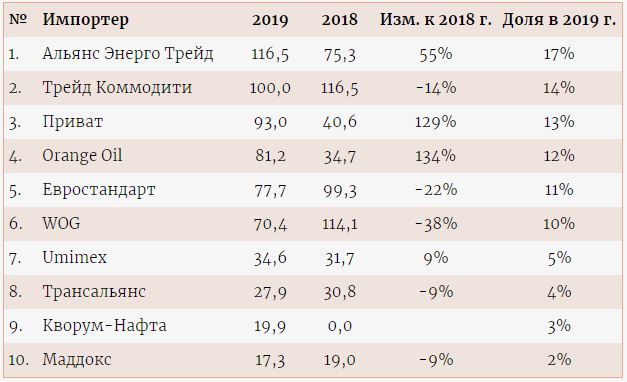
In 2019, the Alliance Energo Trade company became the largest importer of diesel fuel through ports with a volume of 116.5 thousand tons. This was reported to enkorr by the A-95 Consulting Group, citing data from its own research.

Compared to 2018, the Alliance Energo Trade has increased imports by sea by 55% (by 41 thousand tons), rising from fourth to first in the ranking. If in the previous year the bulk was transshipped through the port in Zaporozhye (terminal of Zirka Combine), then in 2019, Odessa became the main delivery port. Through the terminal “Odessanefteprodukt” the company issued 62.4 out of 116.5 thousand tons.

The Trade Commodity group dropped to the second line, reducing the supply by 14% (by 16.5 thousand tons) to 100 thousand tons. The group operates through the Oil Transmission terminal in the port of Nikolaev. From June to August, the work of the terminal was blocked by the power units of the SFS as part of the investigation of the full payment of taxes.

The third line of the rating was taken by the Privat group, which began wholesale sales of diesel fuel from the tanks of the Odessanefteprodukt terminal in June last year. At the end of 2019, the group registered imports of 93 thousand tons of diesel fuel, which is more than twice the volume of supplies a year earlier.

Orange Oil showed the highest growth rates in deliveries, having increased imports from 35 thousand tons to 81 thousand tons. The bulk of the cargo turnover was made up of Israeli and Turkish resources received at the Yuzhny port in the framework of cooperation with the Wexler Group. Also, Orange Oil almost doubled its import through the small ports of Izmail and Ochakov, as well as through the port of Kherson.

Odessa company Eurostandard fell from third to fifth in the rating. Over the year, it reduced marine imports by 22% (by 21.5 thousand tons), to 77.7 thousand tons. If a year earlier, deliveries were mainly carried out through the Odessa port, then in 2019 the emphasis shifted to Yuzhny, where up to 60% of the total volume arrived.

Rating of DT importers by volumes of supplies to Ukraine through seaports in 2019, thousand tons:

As enkorr reported, in 2019 the balance of the Ukrainian diesel fuel market grew by 7.3%, to 6.99 million tons, compared to 2018 (6.52 million tons). The annual market volume reached its maximum value for the entire observation period (since 2004).

In 2019, import by sea increased by 25% (by 142 thousand tons) to 702 thousand tons, and its share in the market balance increased to 10%. This is the maximum annual volume of marine supplies of diesel fuel to the Ukrainian market for the foreseeable period.

Source: enkorr

We are not indifferent to the fate of children!

With such a slogan, our company Alliance Energy Trade LLC entered into 2020. We started our working year with congratulations on the occasion of the New Year and Christmas for a long time for our native orphanage “Cheburashka”, which in the village. Rakitnom, Kyiv region.

 These babies have already become native to us, we have been supporting them for 4 years, and we can say that some of the pupils have grown up in our eyes. It is very nice and at the same time sad to look at the kids who are looking forward to when they finally open these big gift boxes and each of them will be able to play and enjoy them completely… after hugging and thanks…

We congratulate all the friendly staff of the children’s home “Cheburashka” on holidays and wish all the best, kind and light! Let dreams come true, and we will help you in every way!

Petroleum Ukraine 2019

Минулого тижня в Києві в готелі «Hilton» пройшла 11-я конференція Petroleum Ukraine 2019 – один з найбільших форумів, присвячений нафтопродуктів. Організована конференція складалася з восьми сесій, на кожній з яких розглядалися питання, присвячені розвитку сучасного ринку паливної промисловості.

Початок конференції було присвячено важливому питанню – ритейл. Президент Unimot S.A. Адам Сікорський поділився, що в цьому році вони сприяли розвитку абсолютно нового бренду АЗС AVIA на українській території. Таким чином, зараз працює 5 станцій AVIA, але в планах розширення – до 12 АЗС.

Також, на конференції були розглянуті серйозні питання, пов’язані з головними постачальниками палива – це компанії «БНК-Україна», «Укртатнафта» і НАК «Нафтогаз України». По закінченню другого дня організованого зборів порушувалися питання, пов’язані з реформуванням сучасного паливного ринку, були запропоновані важливі рішення і розглянуті актуальні пропозиції.

В результаті конференції було виділено три головні статті експорту в Україну: нафтопродукти, бітум і нафтові гази, що становлять велику частину продуктів. При цьому одним з основних торговельних партнерів країни є Білорусь, що було визначено за результатами 2018 року.

Наша компанія «Альянс Енерго Трейд» виступила в якості партнера і спонсора обідів, беручи активну участь в процесі організації Petroleum Ukraine 2019. Ми вже протягом багатьох років підтримуємо цю конференцію, дозволяючи організувати одне з наймасштабніших заходів в Україні для гостей з різних областей нашої країни, а також для зарубіжних партнерів.

US Department of Energy Predicts Oil Price Drop

The market has adapted to supply disruptions caused by incidents such as the attack on oil refineries in Saudi Arabia, the department said.

The US Energy Ministry expects oil prices to decline in the coming months. This is stated in the monthly report of the Department of Energy of the United States Office (EIA), released on Tuesday, October 8.

The EIA estimates that spot Brent crude oil prices will average $ 59 per barrel in Q4 2019 and then fall to $ 57 per barrel in Q2 2020, down $ 5 from a month ago.

“Despite recent oil supply disruptions, the EIA expects oil prices to decline in the coming months as global reserves increase in the first half of 2020,” the report said.

At the same time, the EIA estimates that prices for Brent will rise to an average of $ 62 per barrel in the second half of 2019. As a result, the projected average price in 2020 will be $ 60 per barrel, which is $ 2 per barrel below the September EIA forecast.
“The October EIA forecast recognizes a higher level of risk of disruptions to oil supplies than previously anticipated, more than offset by growing uncertainty about economic growth and demand for oil in the coming quarters, leading to a lower oil price forecast,” the report said.

Experts believe that the market has been slowly adapting to supply disruptions caused by incidents such as the recent attack on oil refineries in Saudi Arabia.

The day before it became known that the Ministry of Energy of Russia expects in the medium term for the cost of oil at $ 50 per barrel. This was stated by the head of the department Alexander Novak.

Source: korrespondent

Oil rose by more than 1% – the market believes in a breakthrough in negotiations between the US and China

Vartist barrel of listopadovo naphthy Brent 27 sickle until 17:42 according to Kiev put up $ 58.81 (+ 1.19%). The WTI Zhitnefto Nafti Barrel was trading at $ 54.34 (+ 1.30%).

The price of naphtha went to the point of declaring US President Donald Trump about those who want to sign a new trade for the United States. I’m visiting my hometown, Vice Premier of China, Liu Hye half-educated, and now my country is ready to take the super-small hat with a whisper of “calm” talks for stable stability.

Statements, such as sounded from Washington and Pekin, concerned investors, touring with the prospect of a sharp increase in trade between the USA and China, as a result of which the Ministry of Commerce and Trade declined 50%, 78 Viroblenich in the United States. The number of uiyshli sira nafta, sіlskogospodarska products and small lіtaki has been in the country. Trump was instructed by American companies to vivchiti ways to close operational activities in China and transferring virobnitz products to the state.

Tim an hour, the Chinese naphtha giant Sinopec is hoping to get the best rates for importing crude oil from the United States, according to Reuters.

Stock up nafti and gasoline in the United States, yumovorno, passed the last tizhnya. When tsyomu stock distillates virosli. To evaluate the results of the galusevich analysis conducted by Reuters. Expertise is important, but behind the pouches of the last tidy of commerce, stocks of naphtha in the USA were 2.1 million bar.

Informs: enkorr

Trump’s statements pull oil to the bottom

A new round of trade conflict between the US and China has contributed to a record reduction in oil prices. Quotes fell 8% at once. The fall in prices could not be prevented by fears over the so-called “tank war” off the coast of Iran.

US President Donald Trump in his Twitter announced the introduction of new duties on Chinese imports on September 1 this year. The news stunned the markets. Only a month ago, an agreement was reached at a congress in Japan to freeze the total billing process.

Duties will be 10% on goods from the Celestial Republic with a total value of $ 300 billion. This is expected to limit fuel demand for the world’s two largest oil consumers.

Bloomberg financial analysts estimate that prices for “black gold” have experienced the sharpest decline within one week in the last 4 years. As of August 1, 2019, Brent quotations reached $ 60 a barrel.

The cost of the Texas WTI has dropped to $ 53.9 per barrel.

After rising on the last day of the working week (Brent – $ 61.89, WTI – $ 55.69), prices went down again. August 5, as of 09.50 Kyiv time, the price of October futures for Brent was $ 61.06 per barrel. September WTI crude oil futures fell to $ 54.98 a barrel.

New duties will affect almost all Chinese goods. It is likely that the promised 10% may be only the beginning, and in the future will increase the duty to 25%, that is, in fact, “prohibitive” level. It will all depend on whether Chinese President Xi Jinping signs the US-led trade agreement. One way or another, US-Chinese trade issues will remain, according to VM Markets analysts, “the dominant factor shaping oil prices.”

Ukraine imposes a fee on Russian DT and ZVG

The Cabinet of Ministers has determined the final amount of special duties on Russian diesel and liquefied gas, which will come into force on August 1.

On the import of ZN from August 1, a special duty of 3.75% of the customs value of the goods will be applied. The duty is introduced only for pipeline deliveries (90% of the total import of DT from the Russian Federation is on the pipeline).

For liquefied gas, the duty will be set at 1.75% from August.

Starting from October 1, duty rates will be increased to 4% for DT and 3% for liquefied gas.

At the same time, the government refused to introduce quotas on volumes of supplies. In the initial project, an annual QT quota of 2500000 tons was planned (at current annual imports of 2,700,000 tons).

The introduction of duties only on pipeline deliveries to ZN, he explained the “super-market walrus of the trader of the importer”, which carries out import of fuel from the petrochemical pipeline “PrykarpatZapadtrans”.

“The corresponding duties will remove the marginal import trader margin, which arose due to logistics (diesel fuel) and other factors. If a typical walrus in a large opt is $ 10-12 / t, then for the supply of pipeline transport, such a walrus was $ 35-40 / t, “the source reports.

After the introduction of duties on the DT, the wagon suppliers of ZN by pipeline “will be brought to normal market levels, and this will not affect retail prices.”

An additional budget revenue from the introduction of duties, a representative of the president in the government Andrei Gerus, estimated at 2 billion USD per year.

_____

Let’s remind, the Cabinet of Ministers announced the introduction of a fee for the Russian DT on May 15, but to date, this ruling has not been made public.

The draft resolution, which was considered at the meeting on May 15, provided for the introduction of a 2% duty on imports of diesel fuel in the annual volume of up to 2500000 tons and 25% on deliveries beyond this volume. There were no fees for LPG in this project.

The decision to impose restrictions on imports of Russian goods, including a week ago, was adopted in response to unfriendly actions by the Russian Federation, a month before that, on April 18, 2019, imposed sanctions against Ukraine.

Deliveries of ZN from Russia in 2018 provided 40% of the Ukrainian diesel market – 2597000 tons. In the first half of 2019 deliveries grew by 23.2%, to 1380000 tons, compared to the same indicator in 2018, and the share in the balance of the market to 44 %

The import of liquefied hydrocarbon gas from Russia in 2018 amounted to 503 thousand tons. T. Or 29% of the market volume. In the first half of 2019, it grew by 44% to 317.6 thousand. T, and the share in the balance increased to 37%.

Source: enkorr

Oil prices stabilized after the collapse the day before

Oil prices rose on Wednesday after a sharp fall in previous bids. The quotes support was supported by OPEC + alliance extensions to extend the supply limit for raw materials by March 2020 and more than predicted to reduce commercial oil reserves in the US.

The cost of a barrel of September oil Brent on July 3 at 9:07 am in Kiev was $ 62.55 (+ 0.24%). August’s oil barrel WTI traded at $ 56.42 (+ 0.30%). In the course of the previous sessions, the Brent oil fell from $ 65.40 to $ 62.38 per barrel, WTI brand oil – from $ 59.34 to $ 56.22 /

The Organization of Petroleum Exporting Countries and its allies on the eve of the deal agreed to continue reducing oil supplies until March 2020, as its participants overcame internal disagreements, trying to maintain world prices.

“The meeting of OPEC + showed that members of the cartel keep together in difficult times, characterized by deteriorating prospects for world demand and the pursuit of a more balanced oil market, despite the apparent consequences for the market share,” said Amparit Singh, an analyst at Barclays Commodities Research. “It supports oil prices … despite the fact that the market is still focused on weak macro signals.”

The OPEC + agreement on the extension of oil production contraction for nine months should lead to a decrease in crude oil reserves in the second half of this year, which will raise world prices, analysts at Citi Research say.

“The continuation of the reductions by the end of the first quarter is aimed at preventing the entry of [extra] oil into the market during the minimum seasonal demand and the shutdown of a number of major refineries for maintenance. In addition, [signatories to the OPEC + agreement] are trying to gain time to assess the impact of IMO 2020 “, – experts said.

Last week’s commercial oil reserves in the US fell by 5 million barrels. with an expected decline of 3 million barrels, according to data from the American Institute of Oil (API).

However, signs of a slowdown in the global economy have had a negative impact on the growth of oil demand, anxious investors. This worry has grown after world output has gone negative, and the United States has threatened to impose sanctions against the EU in response to state aid from the European aviation industry.

Barclays expects this year’s demand for oil to grow at the slowest pace since 2011 and will be less than 1 bar. / Daily on an annual basis.

Source: Investing.com, Reuters, Enkor

STS has opened a register of tax payers for fuel sales

The State Tax Service has started the daily publication of a single register of payers of excise tax on fuel sales. It is available on the agency’s website.

The publication began on June 14, 2019. The last companies registered in the register are KP “Kyivpastrans” and OOO “Petrol Gas” (Donetsk region). Data on them was made on June 20.

In total in the register as of the morning of June 21, there are 7078 legal entities and individuals-entrepreneurs.

The first entry in this register was made in March 2016. From 2016, 3947 subjects were registered in it, in 2017 it was registered in 1222, in 2017 – in 1283, in 2019 – in 626.

The daily publication of the registry is stipulated by the Procedure for Electronic Administration of the Implementation of Fuel, approved by Government Decree No. 113 dated February 24, 2016.

Previously, checking the presence of the company in this register could be through the electronic cabinet UKRINFORM by the identification code, but a complete list of all registered companies was not available.

As of July 1, the Tax Code introduces mandatory registration of excise warehouses in the system of electronic administration of fuel sales (SARARP), control over turnover of fuel, as well as the introduction of licensing activities for wholesale, retail trade in fuel, storage and production .

These changes were adopted by the Verkhovna Rada in November 2018 at the beginning of July. UKRINFORM released standard forms for applications for licenses and registration of excise warehouses.

According to estimates of the oil and gas association of Ukraine, the entry into force of these changes will reduce the volume of the shadow market.

“The modernized SARAR is aimed at crowding out the shadow market. The new system will take into account the revolutions and remnants of legal fuel separately at each plant, oil tanker, refueling, etc. and will check with the given level meters and flow meters that will be installed in the excise warehouses in 2019 and will show daily the actual volume of turnover and fuel balances, “explained Nelly Privalov, the president of the Oil and Gas Association of Ukraine.

Source: enkorr


Maddox set up a Turkmen DT in Zaporozhye

Maddox company has put tanker in Zaporozhye with Turkmen DT.

The Naviger 1 ship entered the port on May 30. In Maddox, it was clarified that there were 4,500 aboard the tanker. t DT

According to informs, the season of import of Turkmen DT into Ukrainian ports began in late April, when Skywalk Trading Company put two tankers in Kherson and Zaporozhye.

Diesel fuel from Turkmenistan is delivered to Ukraine along the Volga-Don shipping channel with access to the Black Sea. From an economic point of view, this route is the most effective of all possible. In 2018, supplies of DT from Turkmenistan amounted to 187 thousand. t.

The Swiss trader Maddox has a subsidiary – Maddox Ukraine, which sells aviation and diesel fuel in large and small wholesale and is an importer of these petroleum products. The company is trading with oil companies in Kiev, Poltava region, Kherson, Odessa, Korosten, etc. In 2018, Maddox Ukraine imported about 22 thousand t DT and 17 thousand t aviation fuel.

Informs: enkorr

Charity “Chestnut Run”

May 26, 2019, on the Day of Kiev, on the main square of the country passed the 27th “Chestnut Run”. The event was attended by over 15,000 people. Our company “Alliance Energy Trade” also decided to join this event, especially since it is a charity run.

The project collects funds for the purchase of equipment and consumables for the Center for Pediatric Cardiology and Cardiac Surgery of the Ministry of Health of Ukraine. For us, this is a great opportunity not only to show unity and striving for a common goal, but also to help children who need it.

Each of us can change ourselves and our country for the better. Charity marathon is a great way to unite the team and make a contribution to the health of the nation. We thank Irina Kuznetsova – the organizer and initiator of the Chestnut Run, thanks to which it became possible to hold a real holiday that can work wonders for many families! Helping it is nice and fun!

Kremenchug oil refinery reloaded by Ukrtatnafta oil

Ukrtransnafta May 13 traded 20 thousand tons of Azeri Light oil on the electronic stock exchange at the site of the “Ukrainian Energy Exchange” (UES). This is stated in the press service of the company.

The purchaser of the entire volume of oil was PJSC “Naftohimik Prykarpattya”, which purchased raw materials for processing at the Kremenchug oil refinery (PJSC “Ukrtatnafta”). The implementation of 20 thousand tons of Azeri Light grade oil was carried out on terms of shipment from the oil terminal “Pivdennyi”.

The price at the Ukrtransnafta auction was determined by quotations from the Platts agency Azeri Lt FOB Supsa 15 days prior to the registration of the auction application minus the logistics costs associated with the delivery of oil tankers to Ukraine.

According to the source, the Preliminary auction of Ukrtransnafta for the sale of Azeri Light was held on April 24. On it Shebelinsky plant bought 5 thousand tons, Kremenchug oil refinery – 30 thousand tons.

Previously, Ukrtransnafta announced its intention to sell 100 thousand tons of Azeri oil.

JSC “Ukrtransnafta” is the operator of the oil transport system of Ukraine. 100% of its shares are under the management of Naftogaz of Ukraine. The system of trunk oil pipelines Ukrtransnafta with a diameter of 159 to 1220 mm with a total length of 4.7 thousand km runs through the territory of 19 regions of Ukraine. The volume of oil transportation in 2018 amounted to 15.43 million tons, which is 3.7% less than in 2017. Transit declined by 4.3% – to 13.3 million tons, supplies to refineries – remained at the level of 2, 1 million tons

Source: enkorr

BNK resumes fuel supplies to Ukraine

The Belarusian Oil Company (BNK) resumes deliveries of diesel fuel, gasoline and jet fuel in Ukraine, the company said.

“Today, shipments of light petroleum products began in Ukraine in volumes proportional to the commitments formed by existing contracts. A total of 32,000 tons of diesel fuel and 10,000 tons of gasoline will be delivered to the address of Ukrainian buyers CJSC Belarusian Oil Company. The specified volumes will be shipped in the next three to four days, ”the message says.

At the same time, the Belarusian Oil Company continues to operate under force majeure circumstances.

“At present, sufficient reserves of light oil products have been formed in the Republic of Belarus, which meet the needs of the domestic market. This allowed CJSC Belarusian Oil Company to partially export light oil products in the maximum possible volumes under current conditions, ”informs the company.

According to the source, Belneftekhim introduced restrictions on the export of light oil products due to the sharp decline in refining at the refinery, provoked by the supply of poor-quality oil from Russia.

In 2018, the share of Belarusian diesel fuel in the balance of the Ukrainian market was 33%. Last year, the Mozyr and Novopolotsk refineries shipped 2,343,000 tons to Ukraine (-8% compared with 2017).

Belarusian producers remain the main source of supply of gasoline in Ukraine. In 2018, gasoline imports from Belarus to Ukraine amounted to 836.5 thousand tons, which is 44% of the Ukrainian market.

Source: enkorr

Diesel fuel market grew by 10.5% in the first quarter

The volume of diesel fuel supply to the Ukrainian market in the first quarter of 2019 increased by 10.5% (by 133 thousand tons), by 1400 thousand tons, as compared to the 1 st quarter of 2018.

As reported by Dzherero in the “A-95 Consulting Group”, diesel fuel imports grew by 13.5% (145 thousand tons), 1224000 tons, domestic production decreased by 6.3% (by 12 thousand tons), in 175 ths t.

Russia remains the main source of supply of DT to the Ukrainian market. According to the results of the first quarter of the delivery of Russian DT increased by 23% (by 117 thousand tons), up to 625 thousand T and exceeded 50% of the total volume of imports.

Deliveries of Russian ZN by the petrochemical pipeline “PrykarpatZapadtrans” – the main import channel – grew by 22% (105 thousand tons), 573.5 thousand tons T.

Out of this volume 463.4 ths. T was shipped through terminals in Novograd-Volynsky (368.4 thousand tons), Smyga (82.8 thousand tons) and Dubryniches (12.1 thousand tons). The main growth of deliveries came to Novograd-Volynsky – + 13.5% to the same period of 2018

The remaining 110.1 thousand T arrived in Ukraine according to a mixed logistical scheme: an oil product pipeline to Gomel (Belarus), from where the Belarusian-Ukrainian border crossed the carriage-tanks. In comparison with the 1st quarter of 2018, these deliveries grew by 2 times.

In the 1st quarter of 2019, the volume of imports of Belarusian DT increased by 15.6% (by 65.3 ths. T), in 483.5 ths. T. The share of Belarusian fuel in the structure of imports has remained at 39%. Imports from Lithuania decreased by 14.3% (by 11.8 thousand tons) to 70.3 thousand tons. T. imports by sea decreased by 38% (by 26 thousand tons) to 42.9 thousand tons. T.

According to the “A-95 Consulting Group”, diesel deliveries from Russia in 2018 provided 40% of the Ukrainian diesel market. Last year 2597000 tons of imported from Russia were imported.

Recall that on April 18, Russia introduced new sanctions against Ukraine, which stipulates restrictions on the export of crude oil and petroleum products from June 1, 2019.

According to the decision of the Government of the Russian Federation, the export of diesel fuel, propane-butane and straight-runner gasoline in Ukraine from June 1 is possible only on the basis of permits issued by the Ministry of Economic Development.

Source: enkorr

Ukraine has no shortage of fuel due to sanctions of the Russian Federation – NAU

The Naftogaz Association of Ukraine (NAU) does not see the risks of fuel shortages in connection with the decision of the Government of the Russian Federation to impose sanctions against Ukraine. To this conclusion, the NAU came after analyzing the ruling №460-25 of April 18, according to a press release from the association.

“According to this document, from June 1, 2019, the import of diesel fuel, gasoline and liquefied gas to Ukraine will be carried out on the basis of permits of the Ministry of Economic Development and Trade of the Russian Federation. From the document it does not follow that the volumes of fuel will be somehow limited, “- said in a message.

According to representatives of NAU, if fuel suppliers receive timely permission, the situation on the Ukrainian oil market will remain unchanged.

“To date, the criteria and rules by which such permits will be issued, have not yet been published,” experts noted.

The NAU also noted that the degree of diversification of the Ukrainian market exceeds the level of many European states. From 2017, fuel to Ukraine comes from more than 10 countries with the use of various logistics schemes – marine, rail, automobile and pipeline, which allows to organize any deliveries in a short time.

“Therefore, in the event of a delay in the issuance of permits to fuel suppliers, the Ukrainian market is rapidly reoriented to supplies from other countries: Belarus, Poland, Romania, Hungary and others. In this case, there may be slight fluctuations in the cost of fuel due to changes in logistics supply routes “, – summed up in the industry association.

According to the source, on April 18 Russia introduced new sanctions against Ukraine, which stipulates restrictions on the export of oil and petroleum products from June 1, 2019

According to the decision of the Russian government, the export of diesel fuel, propane-butane and straight-run gasoline in Ukraine from June 1 is possible only on the basis of permits issued by the Ministry of Economic Development and Trade.

Announces: enkorr

UGD opened the season selling bitumen

Ukrgasdobycha JSC at an electronic auction on April 16 for the first time this year sold road bitumen. The results of the auction are published by the Ukrainian Energy Exchange (UEB).

The company sold all the 60 tons of bitumen of the 130/200 brand produced at the plant in Lviv region at 14,000 UAH / t.

Recall that during the speech at the seminar “Bitumen: supply and technology”, organized by Consulting Group A-95, the head of sales and marketing at Ukrgasdobycha, Yuri Kuzmin, said that the company’s plans to start purchasing asphalteno tar in the near future contain substances to increase the volume of release of road bitumen.

According to the source, the volume of the bitumen market in 2018 reached a record figure for the last ten years and amounted to 695.5 thousand tons. This is 1.2% more than in the previous year.

Ukrgasdobycha produces bitumen at the Shebelinsky gas processing plant and a bitumen plant in the Lviv region.

Shebelinsky GPP is located in the Kharkiv region and is one of two refineries operating in Ukraine. From 2016, the plant switched to the production of gasoline and diesel fuel of Euro-5 standard. In 2018, the volume of processing of raw materials at the enterprise amounted to 454 thousand tons. In 2018, the plant produced 130.6 thousand tons of gasoline (2.4% of the market volume), 85.1 thousand tons of HP (12.6%) and 31.3 thousand tons of mazut (-7.9%).

Since 2016, the plant’s products are sold on the stock exchange in the electronic auction mode, trading in differentials with the execution of term contracts is also practiced.

Report: enkorr

Orlen has reduced the share of Russian oil at Plotsk oil refinery to 50%

Concern PKN Orlen (Poland) has reduced purchases of Russian oil for the Polish refinery in Plock, to 50% of its load, according to the company’s announcement.

“Every month, about 1,4 million tons of crude oil are supplied to the Plotsky Refinery, of which about 700 thousand T are on average on alternative routes, including from Saudi Arabia,” the report said.

The first long-term oil supply contract between Orlen and Saudi Aramco was signed in 2016. In 2018, the Polish concern imported 3.5 million tons of raw material from Saudi Arabia (approximately 300 thousand T per month). “The just-signed deal will allow Orlen Group to purchase an additional 800 thousand T of Saudi oil, which means that the volume of imported Saudi oil will increase to about 400 thousand tons a month,” the company said.

The first long-term oil supply contract between Orlen and Saudi Aramco was signed in 2016. In 2018, the Polish concern imported 3.5 million tons of raw material from Saudi Arabia (approximately 300 thousand T per month). “The just-signed deal will allow Orlen Group to purchase an additional 800 thousand T of Saudi oil, which means that the volume of imported Saudi oil will increase to about 400 thousand tons a month,” the company said.

All Orlen reduced purchases of Russian oil by 30%, replacing supplies from alternative sources – Saudi Arabia, Norway, Nigeria and Angola.

If in 2007-2013 Russia accounted for more than 90% of the oil imports of PKN Orlen, then its share has now dropped to 70%.

“Thanks to Orlen’s policy of diversifying supply lines, currently 30% of crude oil is being processed at all refineries (Poland, Lithuania, Czech Republic), comes from Russia,” the report said.

PKN Orlen is one of the largest refineries in Central Europe. It manages six refineries: Poland (3), Czech Republic (2) and Lithuania (1), including the ultra-modern refinery in Plotsk (capacity 16.3 million tons). The total processing capacity is 35.2 million tons. PKN Orlen also manages a network of 2803 gas stations: 1787 in Poland, 582 in Germany, 409 in the Czech Republic and 25 in Lithuania. The Group is one of the largest suppliers of petroleum products to Ukraine.

Orlen Lietuva includes the Mazeikiai oil refinery with a capacity of 10.2 million tons / year, the Buting and Birzha oil terminals, as well as the Mazeikiu petroleum trading house (“Mazeikiu nafta”), Orlen Latvija, Orlen Eesti and a number of other companies.

Announces: enkorr

The price of Brent crude exceeded $ 70 per barrel

Futures for Brent crude with delivery in June on Monday morning rose in price to 70.65 dollars per barrel.

This writes UNN referring to the data Bloomberg.

За даними видання станом на 8:09, вартість ф’ючерсів на нафту марки Brent піднялася на 0,44%.

According to the publication as of 8:09, the cost of futures for Brent crude oil rose by 0.44%.

The price of May futures for WTI crude oil rose to 63.38 dollars per barrel, adding 0.48%.

After serious doubts, the traders finally decided to raise the price of Brent oil above $ 70 per barrel, which allowed Saudi Arabia to achieve its first goal for global oil prices for this year.

A positive period for the increase in oil prices, which led to their phenomenal growth of 33% in the first quarter (significant quarterly growth over the past 10 years) continued last Monday after a positive report from OPEC and data on business growth in China’s manufacturing sector.

In March, oil production by 14 OPEC countries fell for the fourth month in a row, dropping by 295 thousand barrels per day to 30,385,000 barrels. According to Bloomberg survey of officials and analysts, as well as information about the movement of tankers, Saudi Arabia has reduced oil production to a minimum of four years – 9,280,000 barrels per day.

The rise in oil prices did not stop even after the American Petroleum Institute (API) on Tuesday published its weekly report on the level of supply and demand in the oil market, which provided for an increase in US oil reserves.

However, a report by the US Department of Energy’s Energy Information Administration (EIA) published on Wednesday confirmed that US crude oil inventories rose by 7,200,000 barrels in the week that ended March 29. The official report on the second week of the growth of oil reserves in the United States, after their increase by 2,800,000 over the previous week, instantly knocked the oil “bulls” off their course. Although the bulk of the growth in oil reserves was related to the problems of shipping oil through the shipping channel of Houston, but the report caused a question about the demand for oil.

However, on Thursday Brent oil prices exceeded the level of $ 70 per barrel for the first time in almost five months and reached $ 70.47 per barrel before dropping to the end of the week. On Friday, prices for American WTI oil reached $ 63.34 per barrel – the maximum since November last year. Oil prices were supported by a good report on US employment in March and optimism about the possible signing of a trade agreement between the US and China. Markets did not respond to the fact that over the past week, American oil producers increased the number of existing drilling rigs by 15. This was the first increase in this indicator in seven weeks.

Reports: oilreview

The new owner of “PrikarpatZapadtrans” intends to organize the pumping of Belarusian diesel fuel

The unitary enterprise “oil-bitumen plant” (Belarus), which in March received permission from the Antimonopoly Committee of Ukraine to purchase the PrikarpatZapadtrans oil product pipeline, plans to organize pipeline deliveries of diesel fuel from the Mozyr oil refinery. The owner of the company, Nikolay Vorobey, said this in an interview with the Belarusian edition of TUT.BY.

“We intend to provide services for the transportation of petroleum products on the export resource of Belarusian refineries, and first of all the Mozyr Refinery, which has direct access to the pipeline system with the possibility of further transportation in the PrikarpatZapadtrans system, and these are supplies to Ukraine and the possibility of transit to other European countries “, – said N. Vorobiev.

He is confident that the logistical advantages of pipeline transport will increase competitiveness and increase the share of the presence of Belarusian fuel in the Ukrainian market.

According to Nikolay Vorobea, after completion of the project on hydrocracking of heavy residues at the Mozyr Oil Refinery, an increase in the output of light petroleum products is expected. “These are the” light “and better transported by pipeline transport,” – said the owner of the company.

As reported by the source, the permission of the Antimonopoly Committee of Ukraine to acquire 50% of the oil-bitumen plant at PrikarpatZapadtrans LLC was received on March 18. The amount of the transaction by the parties is not disclosed. As of the morning of April 3, the owner of the company in the Ukrainian registry is still the Swiss company International Trading Partners AG and its beneficiary, Anatoly Scheffer.

All deliveries of Belarusian diesel fuel in Ukraine are carried out by rail. After the resumption of PrikarpatZapadtrans operation, the volume of supplies of Belarusian diesel fuel in Ukraine decreased by 20% from 2,700,000 tons in 2016 to 2,150,000 tons in 2018, and the market share decreased from 46% to 33%

Oil Bitumen Plant is owned by businessman Nikolai Vorobei, the largest private Belarusian oil trader Interservice. Since 2016, Interservice has supplied to Russia from Belarus ZN of Russian production in the amount of about 60 thousand. Sources in Belarus report that in recent years the company has actively transshipped Russian oil products until last year the scheme was closed by Russia. Directly the “oil-bitumen plant” itself is one of the suppliers of bitumen to the Ukrainian market. In 2018, he sent about 7 thousand tons of this product in Ukraine.

PrikarpatZapadtrans operates a section of the Samara-Zapadnaya Direction oil pipeline with a length of about 1.1 thousand km, intended for pumping diesel fuel from Russia and Belarus both for the internal needs of Ukraine and for transit to Europe, in particular, to Hungary. line capacity – 3,500,000 tons per year.

The pumping of oil products through the Ukrainian oil product pipeline was not carried out for two years prior to the sale due to legal proceedings in Ukraine regarding the ownership of the site and product in the pipe.

In June 2016, the oil product pipelines were restored pumping diesel fuel in Novograd-Volynsky, from September – in Smiga and in May 2017 – in Dubrynichi.

At the end of 2016, Ukraine received 910 thousand tons of pipeline ZN 2017 – 1,800,000 tons, in 2018 – 2,400,000 tons or 37% of the total market balance.

Informs: enkorr

Ukrzaliznytsya has increased tariffs for cargo by 14.2%

JSC “Ukrzaliznytsya” since March 30 increased tariffs for freight by 14.2%, the company said. “The indexation of tariffs for freight rail transportation within Ukraine by 14.2% is the first step towards the introduction of a permanent model of automatic indexation of tariffs for the index of prices of producers of industrial products”, – said in a note. The new system of automatic indexation of tariffs can be elaborated up to July 1 of this year. Earlier, the UZ had planned to raise tariffs since February 1, but then the increase was not agreed upon by the State Regulatory Service. Her agreement was only received on March 22.

The increase in tariffs by 14.2% turned out to be 2.4 p. P Below the plans that UZ announced at the end of 2018. Then in November, it was intended to index the freight rates from February 1, 2019 by 16.6%.

In the “A-95 Consulting Group”, it is noted that the rise in rail freight transportation by 14.2% will cause the growth of large wholesale fuel prices within the range of 20-50 UAH / ton. Specific figures depend on the type of fuel and supply logistics. For example, when transporting LPG from Belarus (border crossing Slavic-Berezhelyte) Art. Korosten Zhytomyrskoy, the cost of the resource will increase by 50 UAH / t (here and thereafter without VAT). Deliveries of Belarusian DT to Korosten can cost the operators 25 UAH / t more.

Transportation of Russian DT via the border crossing of Nightingale Topoli to the station Kupyansk (Kharkiv region). It costs 20 UAH / t, SUG – 35 UAH / t.

According to the results of 2018, the share of rail deliveries in the structure of imports of ZN amounted to 56%, gasoline – 99%, LPG – 78%.

According to the source, the latest increase in tariffs occurred on October 1, 2017, when the services of “Ukrzaliznytsy” for the carriage of goods increased by 15%. In 2018, the Ministry of Economic Development predicted that in 2019-2021, Freight rates for freight will increase annually by 20-25%.

Source: enkorr

CFG Agroholding / Mriya has purchased agricultural machinery for almost $ 2.5 million

This is the first of the planned supplies for the combined CFG / “Mriya” agroholding this year. CFG Agroholding / “Mriya”, which has been operating as a single business since the beginning of 2019, has bought in March a new technology worth $ 2300,000. The press service of the company reports. About this writes propozitsiya.com with reference to the information portal delo.ua. +

According to the report, the combined company replenished its technical park with 17th units of trailed agricultural machinery. In particular, in the new season, 6 fertilizer spreaders of the brand Amazone ZG-TS 10001 ProfisPro with a capacity of 10 tons and a spreading width of 15-54 m and 6 more – the brand Rauch AERO AGT 6036 (capacity of the hopper – 6 tons) are actively engaged in spring field operations. , spreading width – 12-36 m), as well as 5 Kuhn Krause cultivators.
Suppliers of agricultural machinery were Deutsche Agrotechnik Ukraine, Rauch Landmaschinenfabrik GmbH and LLC UAAP.
The agroholding noted that this purchase is the first of the planned supplies of equipment for the joint agroholding CFG / “Mriya” this year. To further ensure the effective production of the company, a joint investor SALIC UK Ltd intends to send several tens of millions of dollars this year to update the CFG / “Mriya” technical park.
Information: In October last year, the Antimonopoly Committee of Ukraine authorized the British Salic UK Limited to acquire shares of 11 enterprises of the agroholding “Mriya”.
Before the sale in August of this year, the agroholding “Mriya” achieved restructuring of the debt. As it was reported, as a result, the total debt burden of the holding will decrease more than three times – up to $ 309 500 000.

For reference:

“Mriya” is a vertically integrated agro-industrial holding, founded in 1992 by Ivan Guta. The Land Bank of the holding is 165 thousand. Ha. The capacity of elevators and grain storage facilities is 380 thousand. Tonne

Notifies: propozitsiya

The All-Ukrainian Road Conference was held in Kiev the other day

The All-Ukrainian Road Conference “Road Industry of Ukraine: State of Affairs and Development Prospects” was held in Kiev the other day, in which our company Alliance Energy Trade acted as the main sponsor and brought together representatives of the business community with representatives of government and industry institutions in the field of road infrastructure.

The aim of the conference was to establish an open dialogue between government and business.

During the event, many problematic issues related to roads were addressed.

State policy in the road sector;
Problem analysis (procurement, logistics, control);
The interaction of road business and the state;
Yaroslav Dubnevich, Chairman of the Verkhovna Rada Committee on Transport, noted that the Verkhovna Rada is working on a draft law on the introduction of an automatic control system on Ukrainian highways..

Earlier, Ukravtodor reported that in the course of 7 months 6 sites will be built for automatic weighing in traffic at the entrances to Kiev on the roads M-01, M-03, M-05, M-06, M-07. It was also noted that this pilot project is planned to expand throughout the country to the construction of 200-250 such points in two or three years.

Alexander Slobozhan, executive director of the Association of Cities of Ukraine, said that: “Roads are a mirror of the economy, so the investor will not enter the society if there is no convenient transport links and proper repaired roads.” Also, questions were raised concerning the discussion of changes in the legislative base, plans for the future construction season, the latest technologies and developments.

China’s oil refining hit a record high in January-February

The volume of oil refining by Chinese refineries in the first two months of 2019 grew by 6.1% over the same period last year to a record daily peak. Growth was ensured by the launch of the refinery by new private refineries, reports fomag.

According to the National Bureau of Statistics of China (NBS), the volume of refining in January and February amounted to 102,490,000 tons. The Statistics Office did not provide data for each month due to the weekend weekend on the occasion of the New Year celebrations on the lunar calendar, which occurred at the beginning of February.

The daily level of processing was about 12680000 bar., Reuters counts, based on NBS data. This figure exceeded the previous high of 12.49 billion bars. / Sut., Achieved in September 2018 The average processing level for all 2018 was 12070000 bps.

NBS data also showed that China has recovered 30690000 tons of oil in the first two months of this year, which is 0.5% more than in the same period last year.

The production rate at the level of 3797000 b / sec decreased from a comparison with 3845000 b / s in December, but exceeded the average for 2018 at 3780000 bps.Natural gas production for the reporting period grew in China by 9.2% yoy to 28.7 billion cubic meters. m. In 2018, production increased by 7.5%.As reported by enkorr, crude oil consumption in China, the world’s largest importer, grew by 6.1% in the first two months of 2019, to a record 12680000 bps.

Source: enkorr

GFS seized aviation fuel for 43 million UAH.

Employees of the tax police office of the major taxpayers of the GFS and GU GFS in the Nikolaev region, together with the border guards under the procedural guidance of the Prosecutor General of Ukraine seized a large batch of fuel in the framework of criminal proceedings on tax evasion.

This was stated by the first deputy chairman of the GFS of Ukraine Sergey Bilan.

So, in February 2019, a tanker flying the flag of Tanzania, which followed the route Greece-Nikolaev with a cargo of aviation fuel, entered the Nikolaev Sea Trade Port.

A package of documents for 961.454 tons of aviation fuel was submitted for customs clearance. At the same time, the maximum carrying capacity of the tanker (deadweight) is 2,465.71 tons, that is, the tanker went underloaded.

As part of the operation “Rubezh”, “Excise-2019” and the investigation of criminal proceedings under Part 3 of Art. 212 of the Criminal Code of Ukraine established a group of persons who entered into a preliminary conspiracy and made unloadings from a specified tanker outside the border and customs control of a consignment of fuel, later transported to one of the tank farms in the city of Nikolayev.

According to the results of the authorized search, 961.136 tons of fuel were found in the indicated tanker at an estimated cost of about UAH 33 million. According to the results of the authorized search at the said tank farm, fuel was found for 10 million UAH.

The total cost of the seized fuel is about 43 million UAH. Investigative actions in criminal proceedings continue.

Report: enkorr

Belarus will seek to replace Russian oil – Lukashenka

If Minsk does not agree with Russia on compensation through tax maneuvers, then it will be forced to switch to oil from other countries, reports the “Agency of Oil and Gas Information” referring to the statement of the president of the republic, Alexander Lukashenko.

“We have a good relationship with Russia. Yes, of course, somewhere we want to squeeze economically, and maybe, really concerned about this tax maneuver. We will survive the absence of these $ 400 million this year, – said the president of Belarus – We will buy oil from the side. Today the oil market is overflowing – a question in the price. “

According to O. Lukashenka, in November Belarus will complete the modernization of its factories, after which the depth of oil refining will be up to 95%, “as in European factories”.

“It costs a lot, but we will finish it. Well, who will benefit from this? We are just at the Russian market, where Russian oil is processed, we will bring someone else’s oil. Russia – is it necessary? No. Well, today, we have to think about it, “Lukashenko said.

In Russia, in 2019-2024, a tax maneuver is planned, that is, a gradual zeroing of the export duty on oil and an increase in the tax rate on mineral extraction (PICC). As a result, prices for Russian oil will increase, duties on export of petroleum products will decrease and Belarus will incur additional costs that Minsk estimated at $ 11 billion in six years.

In January, O. Lukashenka claimed that if Moscow refuses to compensate Minsk for the loss from tax maneuver, it can lose Belarus as its ally.

According to a source, in mid-January, Russian prime minister Dmitry Medvedev at a meeting of the Russian government said that Moscow had never promised to Minsk any financial assistance in connection with the losses incurred by Belarus through the revision of the Russian oil tax.

Provides information: enkorr

In July, the port “Yuzhny” returned to the first place in terms of imports of petroleum products

In July, the seaport “Yuzhny” (Odessa region) received 39.85 thousand tons of imported oil products and came out on top in terms of transshipment among other sea ports, according to statistics from the Administration of the Sea Ports of Ukraine (AMPU).

Compared to June, the port of Yuzhny increased the intake of imported petroleum products by 2.3 times (by 22.4 thousand tons). According to enkorr, in July the bulk of imports fell on DT. The second position is occupied by jet fuel. This year, the import of oil products through the port of Yuzhny is carried out by the WOG Group, Grant-UNT, Maddox, Alliance Energy Trade, Eurostandart, and others.

Until July, the port of Nikolaev held the first place in terms of the volume of imported oil products. In July, it received 30.68 thousand tons of oil products, which is 20.5% (7.9 thousand tons) less than the previous month. The bulk of imports through this port are accounted for by the Trade Commodity group.

In total, the ports of Nikolaev and Yuzhnoye for 7 months of 2018 accounted for almost 80% of all imports of oil products through the ports of the AMPU. During this period, the port of Nikolaev received 175.8 thousand tons of oil products (-21.7% compared to the same period in 2017), the Southern port – 156.3 thousand tons (+ 6.4%).

In just 7 months of 2018, 435.3 thousand tons of oil products were imported through the sea ports that are managed by the AMPU, which is 2.7% less than in the same period in 2017.

In May of this year, after an 18 months pause, the import of petroleum products resumed through the country’s largest oil terminal in the port of Odessa. From May to July, it was imported 43.8 thousand tons of oil products. Previously, enkorr reported on the beginning of deliveries of Turkmen diesel fuel by Skywalk Trading company to Odessa for the company Eurostrendart, as well as import supplies of straight-run gasoline (naphtha) for the petrochemical enterprise Karpatneftekhim.

The biggest growth dynamics in the import of oil products for the period of 7 months of 2018 was shown by the Kherson seaport, having increased the handling by 3.1 times to 48.2 thousand tons.

Recall, the rates of port cathedrals in Ukrainian ports remain higher than in other ports of the Black Sea region. The AMPU explains this by an increased tax burden on ports that transfer about 63% of their revenues to the budget.

As reported enkorr, during his speech at the conference Black Sea Petroleum Trading 2018, the director of the Consulting Group A-95 Sergey Kuiun stressed the importance of the value of offshore oil transshipment complexes in the event of the termination of the supply of petroleum products from Russia and Belarus. According to S. Kuyun, in order to increase the reliability of the oil product supply system, it is necessary to create a state transshipment of oil products, a system of oil and oil products, as well as the revision and formation of the necessary rolling stock

More: http://enkorr.com.ua/a/news/V_iyule_port_Yuzhniy_vernulsya_na_pervoe_mesto_po_obemu_importa_nefteproduktov/233630

The “Kyivteploenergo” voiced plans to reduce tariffs for heat and hot water

“Kyivteploenergo” does not plan to raise tariffs for heat and hot water for the population in connection with the purchase of gas from a private supplier, at the same time tariffs for legal entities may increase.

This UNN reported to the company in response to a request.

“Kyivteploenergo” together with KSCA made every effort to ensure that the gas situation did not affect the tariffs for the population (individuals) and they remained the most comfortable for consumers. For legal entities, submission to the NERCU of documents for the revision of tariffs for the production of heat and electricity in accordance with the market price of gas “, – told in the company.

As noted in “Kyivteploenergo”, for this purpose already prepared the relevant instructions and the process of their harmonization is ongoing.


More: http://oilreview.kiev.ua/2018/08/21/v-kievteploenergo-ozvuchili-plany-po-izmeneniyu-tarifov-na-teplo-i-goryachuyu-vodu/

Kremenchug refinery resumed shipment of gasoline

Kremenchug refinery (Poltava region, Ukrtatnafta) resumed gasoline shipment on August 20, enkorr market participants informed.

“The bulk of fuel is shipped by road. Shipment by rail will resume within a week, “a representative of one of the traders said.

At the same time, according to enkorr, at the moment diesel fuel is shipped not more than 3-4 wagons to one contractor.

As reported enkorr, August 14, “Ukrtatnafta” resumed shipment of diesel fuel by automobile norms.

Recall that on the morning of August 9 at Kremenchug refinery there was a fire of one of the process units due to which the plant stopped shipment of fuel.

More: http://enkorr.com.ua/a/news/Kremenchugskiy_NPZ_vozobnovil_otgruzku_benzinov/233552

On June 26, the Forum will start its activity: “Electricity market of Ukraine: implementing changes”

26-27 червня 2018 Координаційний центр із забезпечення введення нового ринку електричної енергії при Кабінеті Міністрів України (Координаційний центр) за підтримки проекту Агентства США з міжнародного розвитку (USAID) «Розвиток енергетичних ринків в Україні» організовує дводенний Форум «Ринок електроенергії України: втілюючи зміни».

Про це йдеться на офіційній сторінці Координаційного центру.

Форум складатиметься з двох частин і розрахований на широку аудиторію, зацікавлену в темі впровадження нового ринку електричної енергії. Стратегічна сесія, яка відбудеться в перший день розрахована на ключових учасників ринку електричної енергії, фахівців, експертів, політиків, представників державних органів виконавчої влади та громадських організацій, і передбачає обмін баченнями і думками щодо основних проблем, що стоять на шляху впровадження нового ринку електроенергії.

Дискусія за участю професійного модератора, разом з презентаціями на ключові теми побудови нового ринку електроенергії, мають на меті визначити головні проблемні питання, за якими необхідна підтримка з боку уряду, НКРЕКП, національних і міжнародних партнерів, а також законодавчі зміни, які дозволять впровадити новий ринок електричної енергії у визначений законодавством термін.

Семінар / тренінг, який відбудеться у другий день розрахований на фахівців / представників учасників ринку, які задіяні в процесах, пов’язаних з «відділенням» (анбандлінгом) діяльності з розподілу електричної енергії від інших видів діяльності, і введенням діяльності постачальників універсальної послуги, – йдеться в повідомленні.

Місце проведення: Президент Готель, вул. Госпітальна, 12, Київ.

Робочі мови: англійська та українська із забезпеченням синхронного перекладу.

The Nord Stream – 2 project implementation is hardly probable, according to the American diplomat

“American sanctions and a weakening European consensus make contentious construction of the Nord Stream – 2 pipeline is even less possible than ever”, assures the American diplomat John Herbst.

‘Terminal’ writes about it, referring to the American  Interest website materials.

The American diplomat John Herbst in publications on the website has noted that nowadays there is a struggle over the controversial project to transport natural gas directly to Germany, bypassing Ukraine, Belarus, and Poland, it focuses on the issue of obtaining permission from the Governments for laying the pipeline in their territorial waters, as well as from all the European Union. “However, these are not the only obstacles to be overcome in order to start the construction of the Nord Stream – 2 pipeline,”  D. Herbst wrote.

In his view, the Nord Stream – 2 project faces serious opposition in the European Commission, which would like to see the implementation of a joint EU energy policy in accordance with the Third Energy Charter.

The final difficult issue in the implementation of this project is linked to Germany. Concerned German businesses actively support this project. Federal Chancellor Merkel also formally stands in its support. She understands that after the active support of sanctions against Russia she was to offer something to business representatives who support her. However, she demonstrated her inclination to nuances and publicly acknowledged that Nord Stream – 2 is also a geopolitical project that is denied in the strongest terms by its supporters. “The Federal Chancellor is a very influential politician, but she will hardly use all her capabilities to ensure success of this project,” the diplomat said.

Read in the ‘Terminal’, the President of Ukraine Petro Poroshenko declares that the authorities of the country create a group in the European Union, which should stop the construction of the second line of the Russian gas pipeline bypassing Ukraine Nord Stream – 2, it also  negotiates with Germany on the establishment of an international consortium for the management of the Ukrainian gas transport system (GTS).

Learn more: http://oilreview.kiev.ua/2018/06/20/realizaciya-proekta-severnyj-potok-2-maloveroyatna-amerikanskij-diplomat/

Capacity of the first stage of the fourth Oil Refinery in Kazakhstan will be 3 million tons

Capacity of the first stage of the fourth Oil Refinery in Kazakhstan will be 3 million tons, according to media citing the Energy Minister of the Republic of Kazakhstan Kanat Bozumbaev.

Total processing capacity of plant will reach 6 million tons. Technical parameters and mechanisms for funding of oil refineries will be known in the second half of the year.

“One of the important tasks for oil processing is the construction of a new oil refinery plant. A working group for the elaboration of an Initial Feasibility Study has been created. In the second half of the year we will decide on the future possible location of the plant,” said K. Bozumbayev.

The decision to build the fourth Oil Refinery in Kazakhstan was adopted on the basis of forecast balance, created by the Working Group under the Government of the Republic of Kazakhstan  “According to conducted analysis, the modernization of Oil Refinery covers the major types of fuel and lubricant materials the market needs, but it covers them in unstable manner and for the short term. While shortage of motor gasoline will be formed between 2021 and 2023, diesel fuel — between 2018 and 2023, aviation fuel — after 2026”.

Materials, posted on the website of the Government of the Republic of Kazakhstan, stipulate that any unscheduled termination in operation of Oil Refineries in the Republic leads to shortage of fuel and lubricant materials in the domestic market resulting in increased prices for petroleum products.

Currently, in Kazakhstan Atyrau, Pavlodar and  Shymkent oil refineries operate. Enterprises as of 2016 could annually process about 14.5 million tons of oil, that is for 2-3 million tons lower than the country needs.

Source http://www.nefterynok.info/novosti/moschnost-pervoy-ocheredi-chetvertogo-npz-v-kazahstane-sostavit-3-mln-tonn